
Blog / Customer Experience
100 Customer Service Survey Questions for 2026
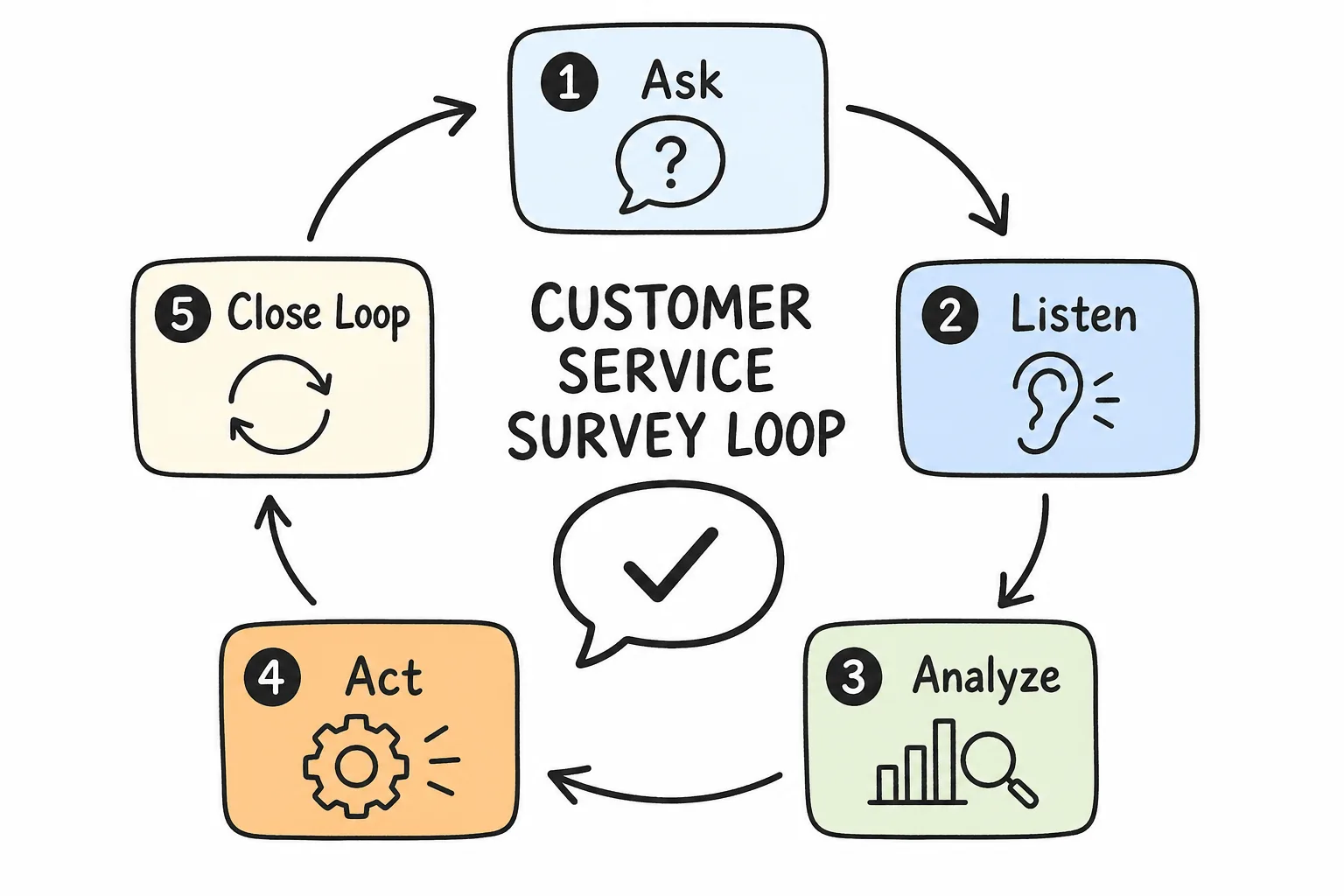
Context
A practical bank of 100 customer service survey questions for 2026, plus CSAT, NPS, and CES guidance, templates, timing rules, and close-the-loop best practices for support and CX teams.
On this page
Customer service survey questions are how support, CX, and operations teams turn lived experiences into decisions. The right questions show whether an interaction felt easy, whether the issue was resolved, and whether the customer is likely to stay.
The American Customer Satisfaction Index reported a national score of 76.9 out of 100 for Q4 2025-flat for six months and still near levels last seen years earlier. Survey programs that only chase vanity scores miss quiet churn risk. Programs that ask precise questions, act quickly, and close the loop catch it earlier.
This guide gives you 100 ready-to-use customer service survey questions, organized by metric and use case, plus templates, timing rules, and common mistakes. When you are ready to ship a short survey, use how to turn a prompt into a shareable form so the bank becomes a live link instead of a spreadsheet tab.
What Are Customer Service Survey Questions?
Customer service survey questions are short prompts sent after (or about) a support interaction to measure satisfaction, effort, loyalty, or specific service attributes.
They differ from broad product or brand surveys in three ways:
- They are transactional. Most focus on a ticket, call, chat, or self-service attempt - not the entire relationship.
- They are time-sensitive. Memory fades quickly. The best questions arrive while the experience is still fresh.
- They are operational. Answers should route to queue design, coaching, knowledge base fixes, staffing, and product friction - not only to an executive dashboard.
A strong survey question is specific, single-focus, neutrally worded, and matched to a clear scale. A weak question is vague, leading, double-barreled, or asked too late to produce honest recall.
Treat survey questions as instruments for operations, not as a scoreboard for PR.
Why Customer Service Surveys Matter
Support is often the moment customers decide whether a company is easy to work with. Research popularized through Customer Effort Score work (Corporate Executive Board studies later covered in Harvard Business Review) argued that high-effort experiences drive disloyalty far more than low-effort experiences do. Widely cited figures from that research stream put roughly 96% of customers with high-effort service interactions as more disloyal, versus about 9% after low-effort experiences. Treat those percentages as directional history from that study stream-not as a fresh 2026 benchmark.
That insight still shapes modern CX programs:
- Customers forgive imperfect outcomes when the path feels easy.
- Customers churn when they repeat themselves, wait too long, or bounce across channels.
- Delight campaigns rarely outperform friction removal.
Surveys also protect internal decision quality. Without structured feedback, teams optimize for what is easy to measure inside the help desk - handle time, tickets closed - instead of what customers felt. Scores plus open comments reconnect those two worlds.
For B2B teams, response coverage matters as much as the score itself. CustomerGauge reports average B2B survey response rates near 12.4%, with a wide range across programs. If only the happiest accounts reply, your dashboard lies. Design questions and invitations that make responding easy, then track coverage by revenue segment.
CSAT, NPS, and CES: Which Metric Fits Which Question?
Most customer service survey programs use three core metrics. They answer different questions. Mixing them without a plan creates noise.
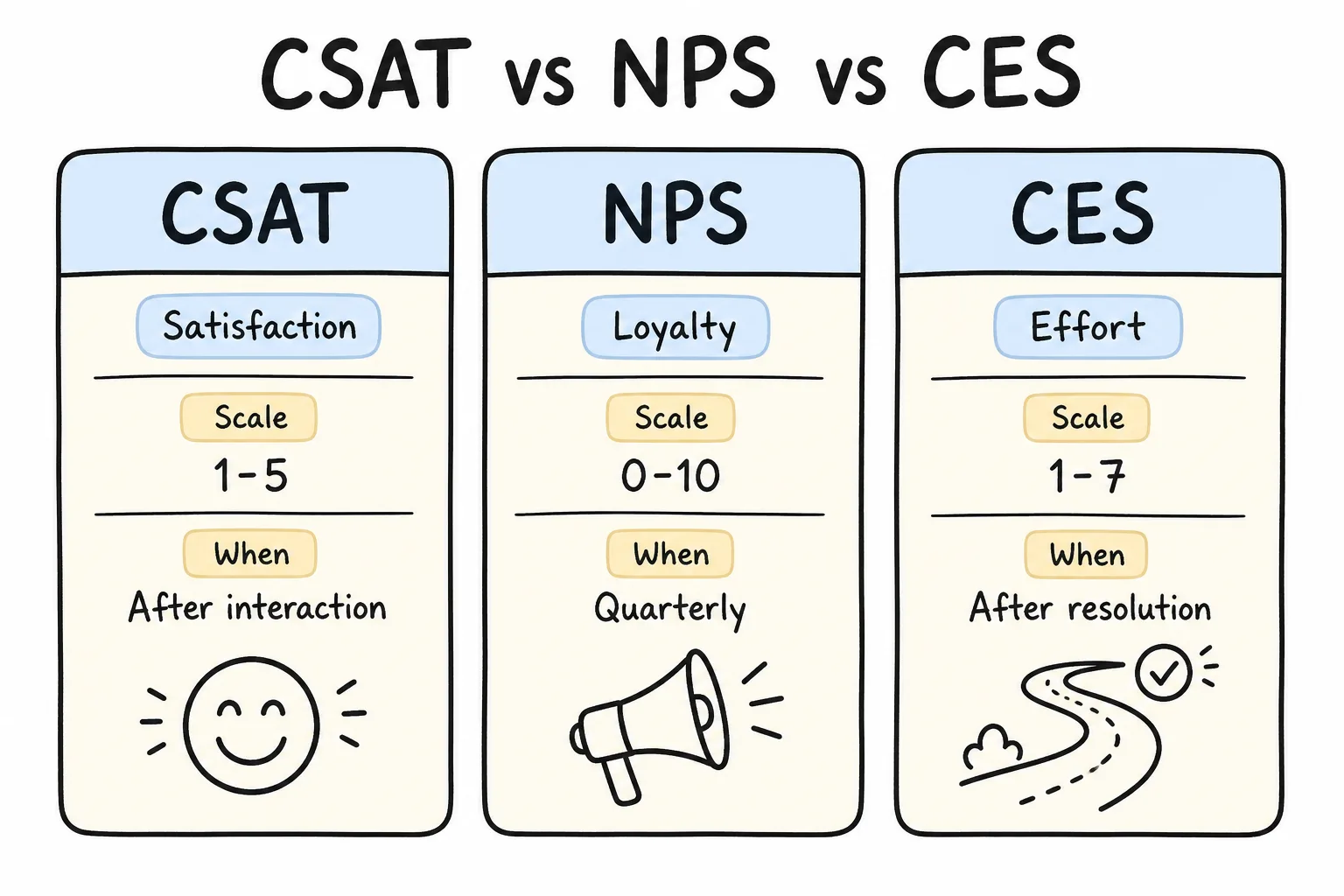
CSAT measures a moment. NPS measures a relationship. CES measures friction.
Customer Satisfaction Score (CSAT)
What it measures: Happiness with a specific interaction, product moment, or support outcome.
Typical question: “How satisfied were you with the support you received today?”
Common scale: 1–5 (or 1–7). Positive responses are usually the top two boxes.
Formula:
CSAT = (Number of satisfied responses ÷ Total responses) × 100
Example: 80 of 100 respondents rate 4 or 5 on a 5-point scale → 80% CSAT.
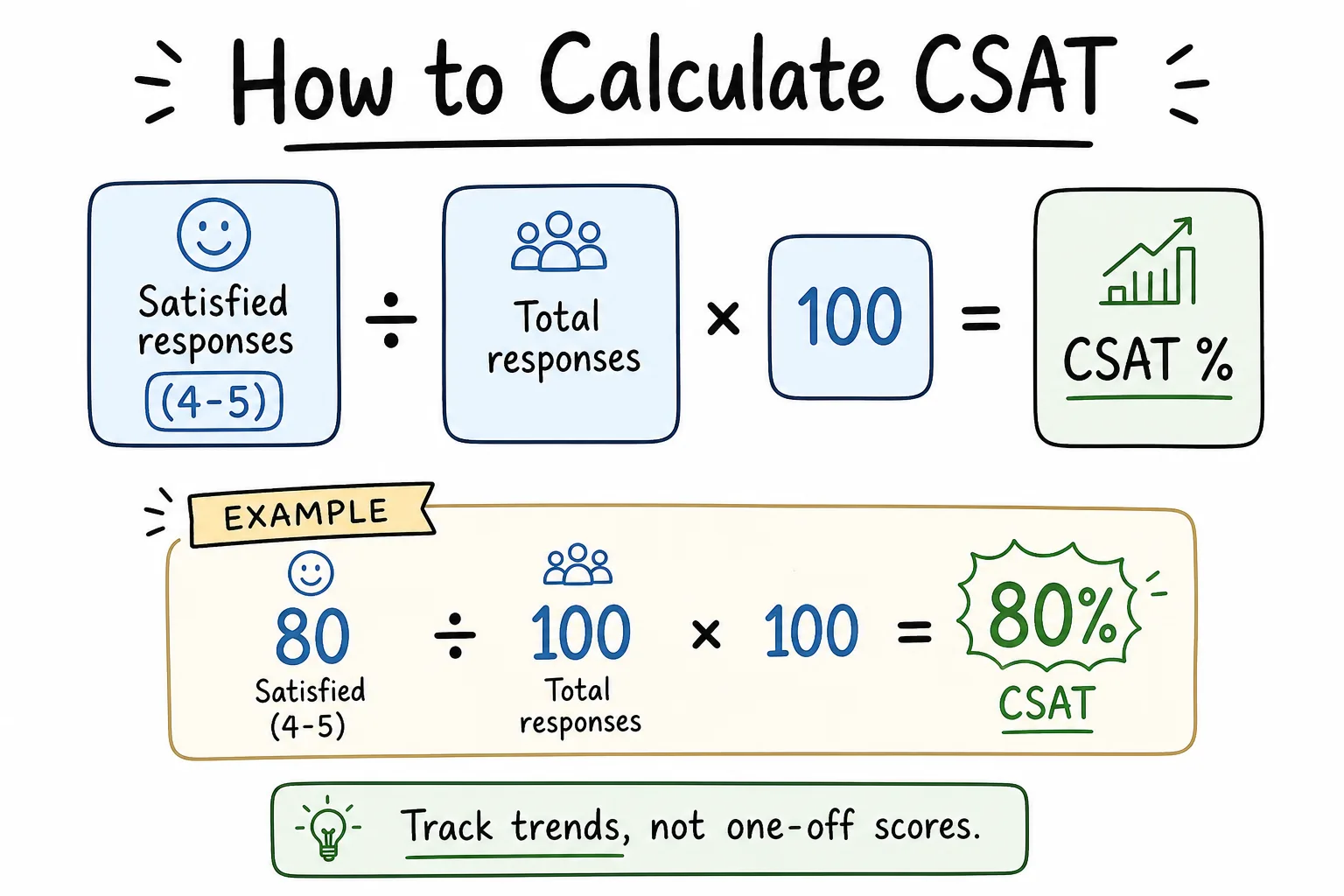
CSAT is a percentage of positive ratings - track the trend, not a single week.
Best used: Immediately after ticket resolution, chat close, or call wrap-up.
Net Promoter Score (NPS)
What it measures: Likelihood to recommend - a proxy for loyalty and advocacy.
Typical question: “How likely are you to recommend our company to a friend or colleague?”
Scale: 0–10.
Segments:
| Segment | Score | Meaning |
|---|---|---|
| Promoters | 9–10 | Loyal advocates |
| Passives | 7–8 | Satisfied but uncommitted |
| Detractors | 0–6 | At risk of churn or negative word of mouth |
Formula:
NPS = % Promoters − % Detractors
Best used: Quarterly relationship checks, post-onboarding milestones, or renewal windows - not after every ticket.
Customer Effort Score (CES)
What it measures: How easy it was to get help or complete a task.
Typical question: “The company made it easy for me to handle my issue.” (Agree/disagree)
Common scale: 1–7.
Best used: After resolutions, self-service attempts, returns, password resets, or any flow where friction predicts churn.
Quick decision guide
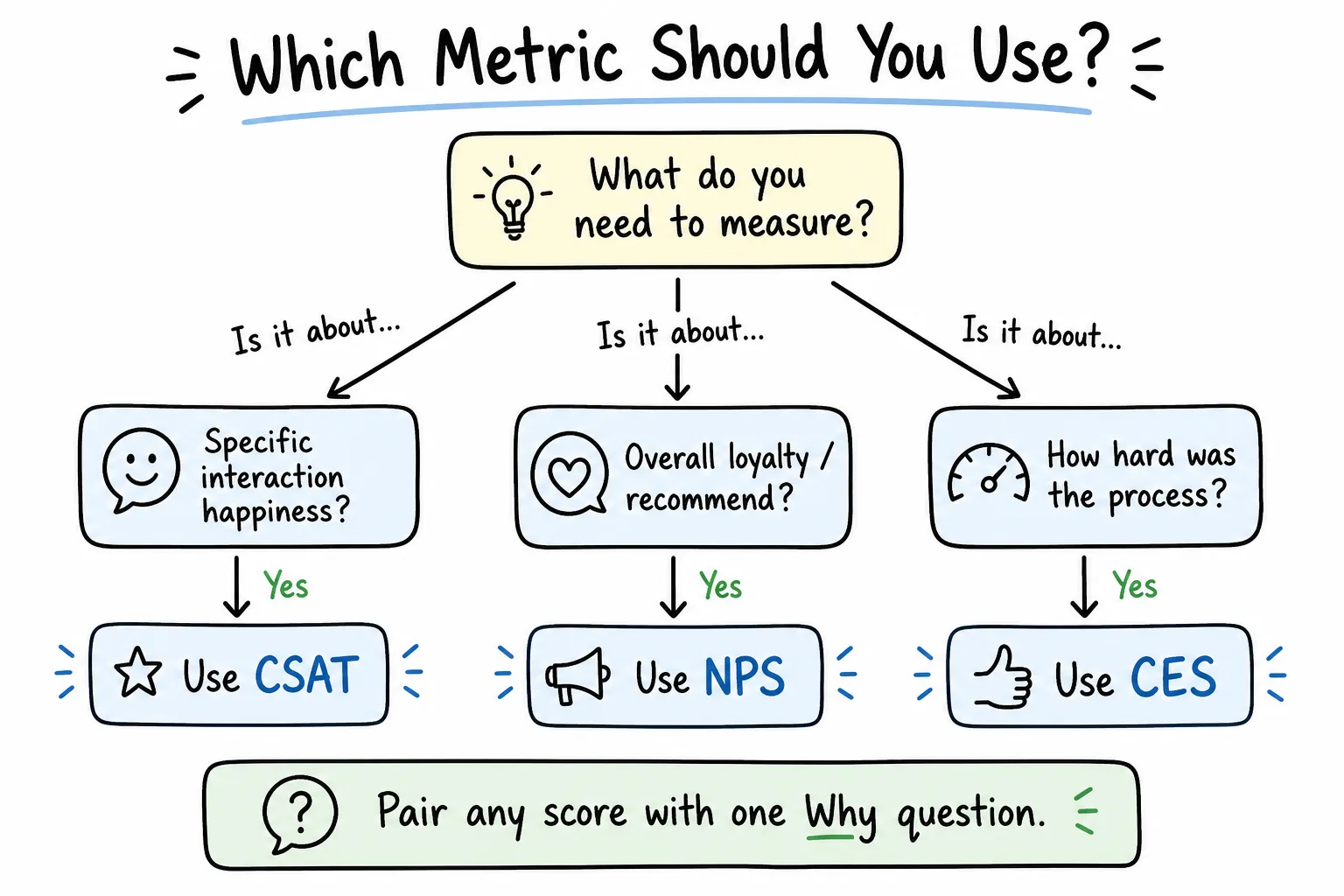
Pick the metric that matches the decision you need to make, then add one “why” question.
| If you need to know… | Use | Cadence |
|---|---|---|
| Was this interaction good? | CSAT | After each resolved contact |
| Was this hard to do? | CES | After resolution or self-service |
| Will they stay and recommend us? | NPS | Quarterly / lifecycle |
| Why did they score that way? | Open-ended | Alongside any metric |
Pair every primary score with one optional open-ended question. The number shows what changed. The comment shows what to fix.
How to Design Customer Service Survey Questions
Before you copy any question bank, lock four design rules.
1. One idea per question
Bad: “Was our agent friendly and knowledgeable?” Good: Ask friendliness and knowledge separately, or pick the attribute you will coach on.
2. Neutral wording
Avoid “How amazing was our lightning-fast support?” Leading language inflates scores and destroys trust in the data.
3. Match the moment
Ask about the ticket that just closed, the chat that just ended, or the article the customer just read. Vague “overall support” questions blur causes.
4. Keep transactional surveys short
For post-interaction surveys, aim for 1–3 questions (score + optional why). Longer relationship surveys can run longer, but response rates usually fall as length grows. Keep event-triggered surveys under five questions when you can. Overbuilding surveys has the same cost as overbuilding forms-extra fields burn your time and theirs.
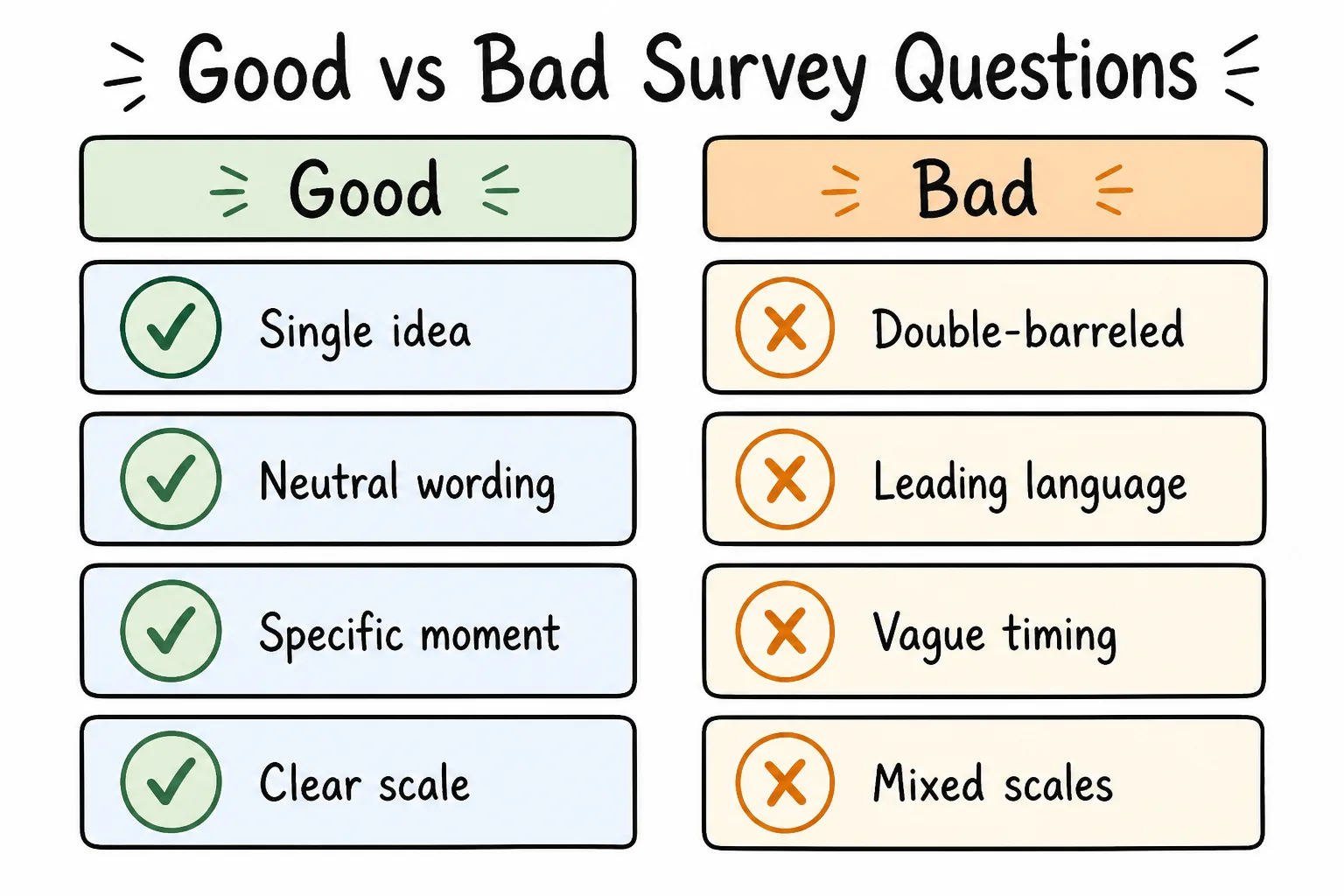
Single-focus, neutral, specific questions produce cleaner data than leading or double-barreled prompts.
Question types that work in support surveys
| Type | Best for | Watch-outs |
|---|---|---|
| Likert / rating | CSAT, CES, attribute ratings | Keep scale labels consistent |
| NPS (0–10) | Loyalty | Do not send after every ticket |
| Dichotomous (Yes/No) | Binary outcomes (resolved?) | Follow with a why if “No” |
| Multiple choice | Channel preference, issue category | Limit options; allow Other |
| Open-ended | Root cause, verbatim insight | Optional on short surveys |
| Ranking | Priority of improvements | Use sparingly; harder on mobile |
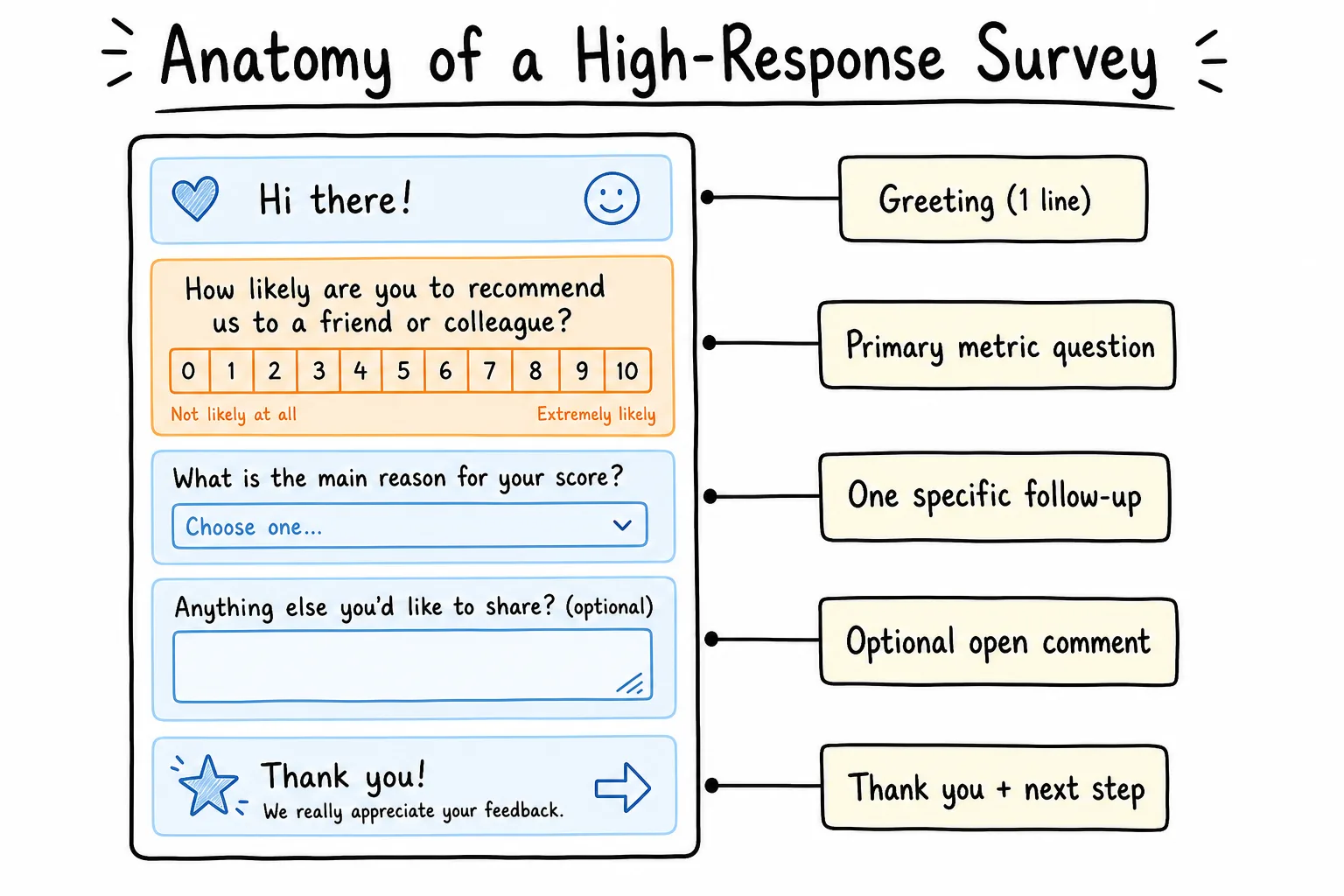
High-response surveys stay short: greeting, primary metric, one follow-up, optional comment, thank-you.
100 Customer Service Survey Questions
Use these as a question bank, not a single mega-survey. Pick 1–5 questions that match the trigger, channel, and decision you need.
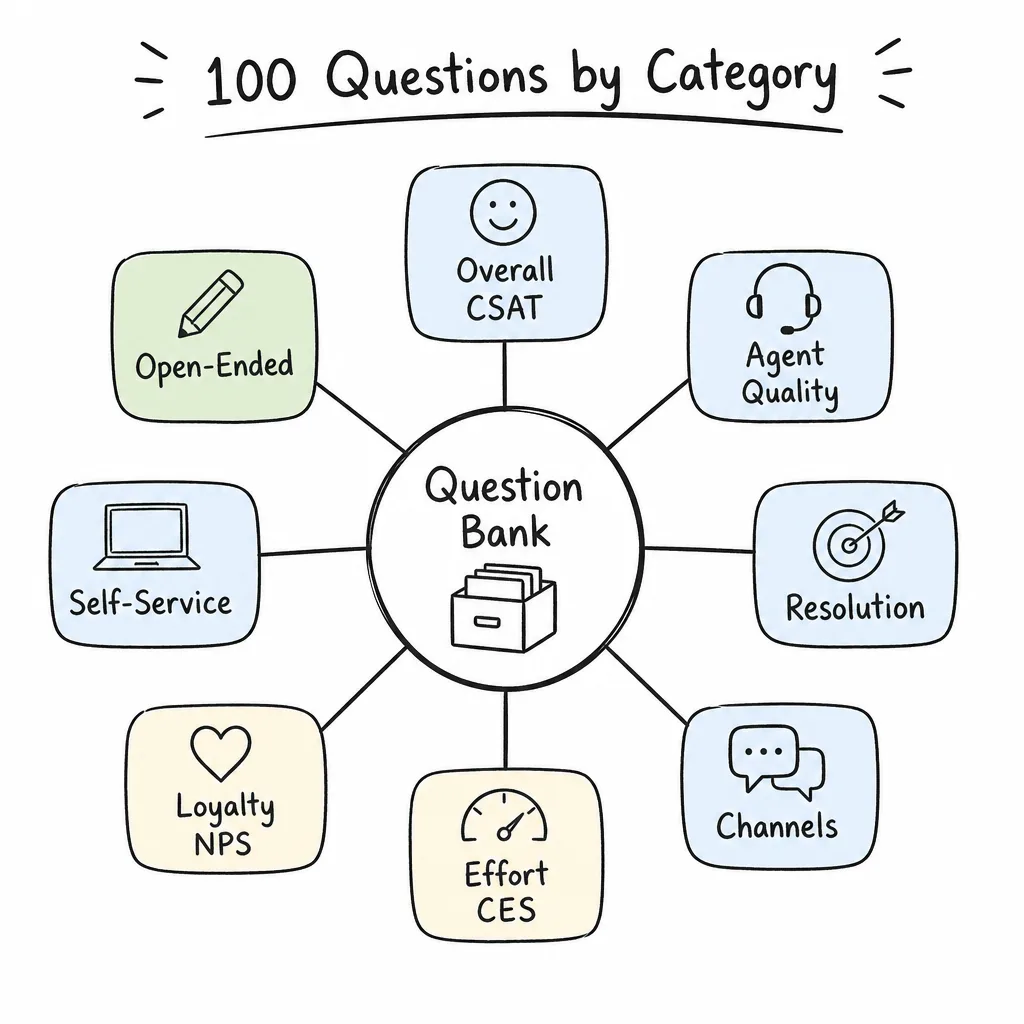
Build surveys from categories - never dump the full bank into one form.
A. Overall satisfaction (CSAT) - Questions 1–10
- How satisfied were you with the support you received today?
- Overall, how would you rate your most recent customer service experience?
- How satisfied are you with the outcome of your support request?
- Did this interaction meet your expectations for our customer service?
- How would you rate the quality of the help you received?
- Compared with your expectations, how satisfied are you with this support experience?
- How satisfied are you with our customer service overall this month?
- How would you rate your satisfaction with the way we handled your issue from start to finish?
- On a scale of 1–5, how satisfied are you with our support team’s performance on this request?
- How likely are you to rate this support experience as excellent?
B. Agent quality and professionalism - Questions 11–22
- How courteous was the agent who assisted you?
- How professional was the agent during your interaction?
- How well did the agent listen to your concern?
- How empathetic was the agent to your situation?
- How knowledgeable did the agent seem about your issue?
- How clearly did the agent explain the next steps?
- How patient was the agent while resolving your request?
- Did the agent communicate in a way that was easy to understand?
- How confident are you in the guidance the agent provided?
- How personalized did the support interaction feel?
- Would you want to work with the same agent again if you needed help?
- How would you rate the agent’s ownership of your issue?
C. Resolution quality and first-contact resolution - Questions 23–34
- Was your issue fully resolved during this interaction?
- How satisfied are you with the solution provided?
- Did we resolve your issue on the first contact?
- How effective was the solution in solving your problem?
- How long did it take to reach a final resolution?
- Did you need to contact us more than once about the same issue?
- How complete was the information we gave you to prevent the issue from recurring?
- Were you transferred to another person or team during this request?
- If transferred, how smooth was the handoff?
- How satisfied are you with any workaround we provided?
- Did the resolution address the root cause, or only a symptom?
- After this interaction, do you feel equipped to handle a similar issue yourself?
D. Speed and responsiveness - Questions 35–42
- How satisfied are you with how quickly we responded to your initial contact?
- How would you rate our response time for this request?
- Did we reply within the timeframe we promised?
- How satisfied are you with the time it took to resolve your issue?
- How acceptable was the wait time before you reached an agent?
- How proactive were our updates while your issue was open?
- Did you feel we kept you informed throughout the process?
- How would you rate the speed of follow-up after your issue was marked resolved?
E. Channels and accessibility - Questions 43–52
- How easy was it to find a way to contact support?
- Were you able to reach us through your preferred channel?
- Which channel did you use for this interaction? (Chat / Email / Phone / In-app / Social / Other)
- How satisfied are you with support on [channel used]?
- How consistent is our service quality across channels?
- How easy was it to switch from self-service to a live agent when needed?
- Did you have to repeat your issue when changing channels?
- How satisfied are you with our business hours / availability?
- How accessible was support for your language or accessibility needs?
- What support channel would you most like us to improve or add?
F. Customer effort (CES) - Questions 53–62
- The company made it easy for me to handle my issue. (Strongly disagree → Strongly agree)
- How easy was it to get the help you needed today?
- How much effort did you personally have to put in to resolve your issue?
- How easy was it to explain your problem to us?
- How easy was it to find relevant help before contacting an agent?
- How simple was the process from first contact to resolution?
- Did you have to re-enter or repeat information you already provided?
- How easy was it to track the status of your request?
- Compared with other companies you use, how easy is it to get support from us?
- What was the hardest part of getting your issue resolved?
G. Communication clarity and knowledge - Questions 63–70
- How clear were the instructions you received?
- How accurate was the information provided by support?
- Did our answers use language you could understand without jargon?
- How helpful were any links, screenshots, or resources we shared?
- Did we confirm that you understood the solution before closing the ticket?
- How consistent was the guidance if more than one agent assisted you?
- How well did we document what was done on your account or order?
- Were any policy or limitation explanations clear and fair?
H. Self-service and help center - Questions 71–78
- How easy was it to find an answer in our help center?
- Did our help articles resolve your issue without contacting an agent?
- How relevant were the suggested articles to your problem?
- How clear and up to date was the documentation you used?
- How satisfied are you with our in-product guidance or tooltips?
- How easy was it to use our FAQ or community forum?
- What topic should we add or improve in our self-service content?
- After using self-service, how confident are you that the issue is fixed?
I. AI, bots, and automated support - Questions 79–86
- Did you interact with an AI assistant or chatbot during this experience?
- How helpful was the AI assistant in understanding your issue?
- How satisfied are you with the answers provided by automation before reaching a human?
- How easy was it to escalate from the bot to a human agent?
- Did automation save you time on this request?
- How accurate were the automated suggestions or troubleshooting steps?
- How comfortable are you receiving support from AI for issues like this?
- What should our AI assistant do better next time?
J. Loyalty, advocacy, and relationship (NPS-style) - Questions 87–94
- How likely are you to recommend our company to a friend or colleague? (0–10)
- How likely are you to continue using our product or service based on this support experience?
- How likely are you to buy from us again after this interaction?
- How has this support experience affected your trust in our company?
- How likely are you to contact support again if another issue arises?
- Based on support alone, how do we compare with alternatives you know?
- How likely are you to leave a public review about this experience?
- What is the primary reason for the score you just gave?
K. Open-ended improvement questions - Questions 95–100
- What is the main reason for your rating?
- What is one thing we could have done better?
- What surprised you - positively or negatively - about this support experience?
- If you could change one part of our customer service process, what would it be?
- Is there anything else you want our team to know?
- May we follow up with you about your feedback? (Yes / No)
For post-ticket CSAT, a practical micro-survey is questions 1 + 23 + 95. For effort-focused ops work, use 53 + 59 + 62. For quarterly loyalty, use 87 + 94.
Ready-to-Use Survey Templates
Copy these into your help desk, in-app survey tool, or form builder. Keep them short and mobile-friendly-most respondents will answer on a phone. If you build from a phone yourself, see why forms should start on your phone.
Template 1: Post-ticket CSAT (2–3 questions)
Trigger: Ticket status = Solved
Channel: Email or in-app
Goal: Interaction quality
- How satisfied were you with the support you received today? (1–5)
- Was your issue fully resolved? (Yes / No / Partially)
- Optional: What is the main reason for your rating?
Routing rule: Scores of 1–2 → create follow-up task for team lead within 24 hours.
Template 2: Customer effort after resolution
Trigger: Complex workflows (returns, billing changes, permissions, migrations)
Goal: Find friction
- The company made it easy for me to handle my issue. (1–7)
- Did you have to repeat information you already provided? (Yes / No)
- What was the hardest part of getting your issue resolved?
Template 3: Chat / messaging micro-survey
Trigger: Chat closed
Goal: High response, low friction
- How satisfied are you with this chat? (emoji or 1–5)
- Optional comment
Keep it to one screen. Messaging surveys win on response rate when they stay tiny.
Template 4: Quarterly support NPS (relationship)
Trigger: Every 90 days for active customers; suppress if surveyed in last 60 days
Goal: Loyalty signal tied to support perception
- How likely are you to recommend our company to a friend or colleague? (0–10)
- What is the primary reason for your score?
- Optional: How has support influenced that score in the last quarter?
Template 5: Self-service article feedback
Trigger: After help-center article view (thumbs or short form)
Goal: Content quality
- Did this article solve your problem? (Yes / No)
- If no, what was missing?
- Optional: How easy was this article to understand? (1–5)
Template 6: AI assistant evaluation
Trigger: Bot session ends or handoff to human
Goal: Automation quality without blocking escalation
- How helpful was the AI assistant? (1–5)
- Was it easy to reach a human when you needed one? (Yes / No)
- What should the assistant do better?
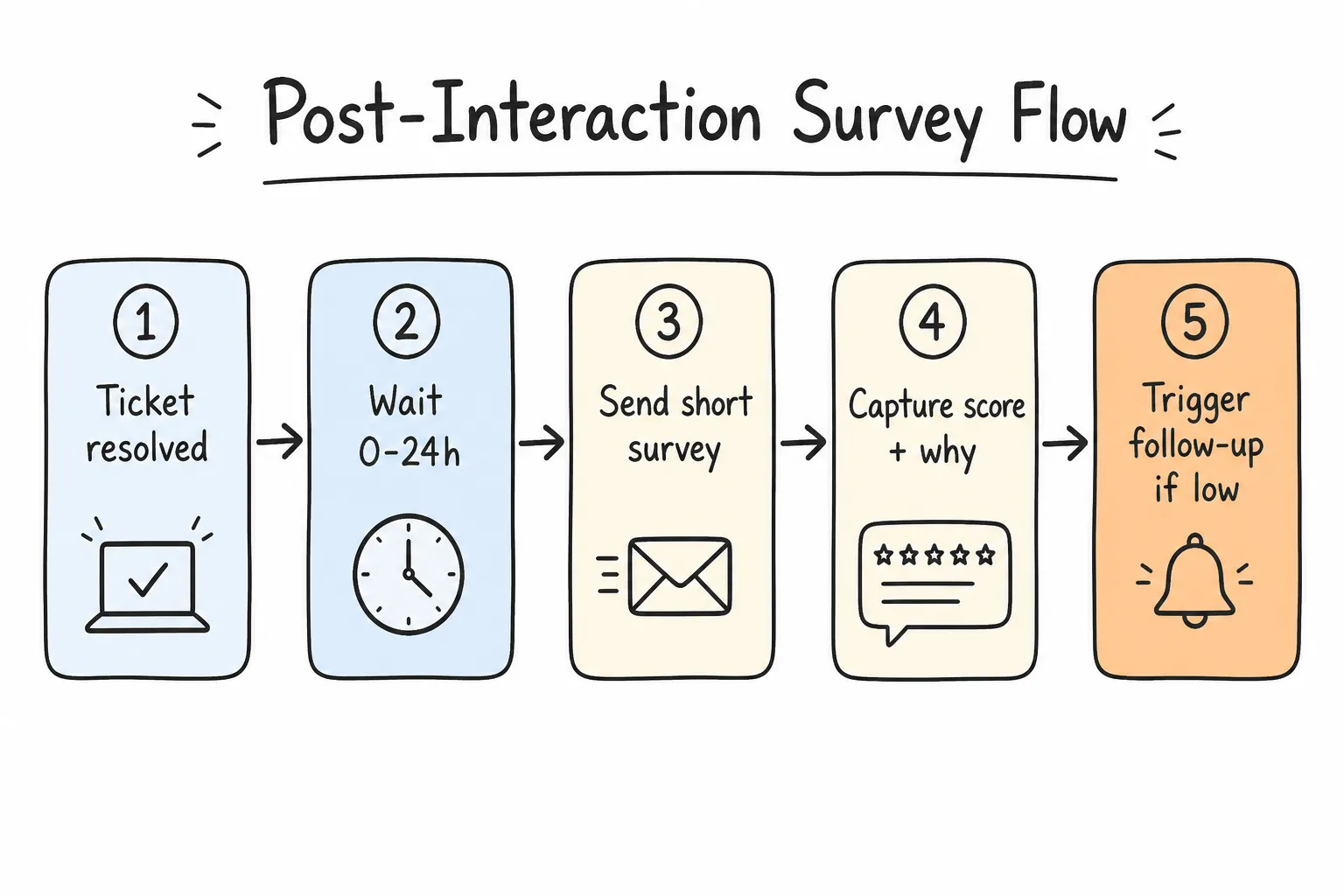
Send quickly after resolution, capture score plus why, then follow up on low scores.
When to Send Customer Service Surveys
Timing is a design decision, not an afterthought.
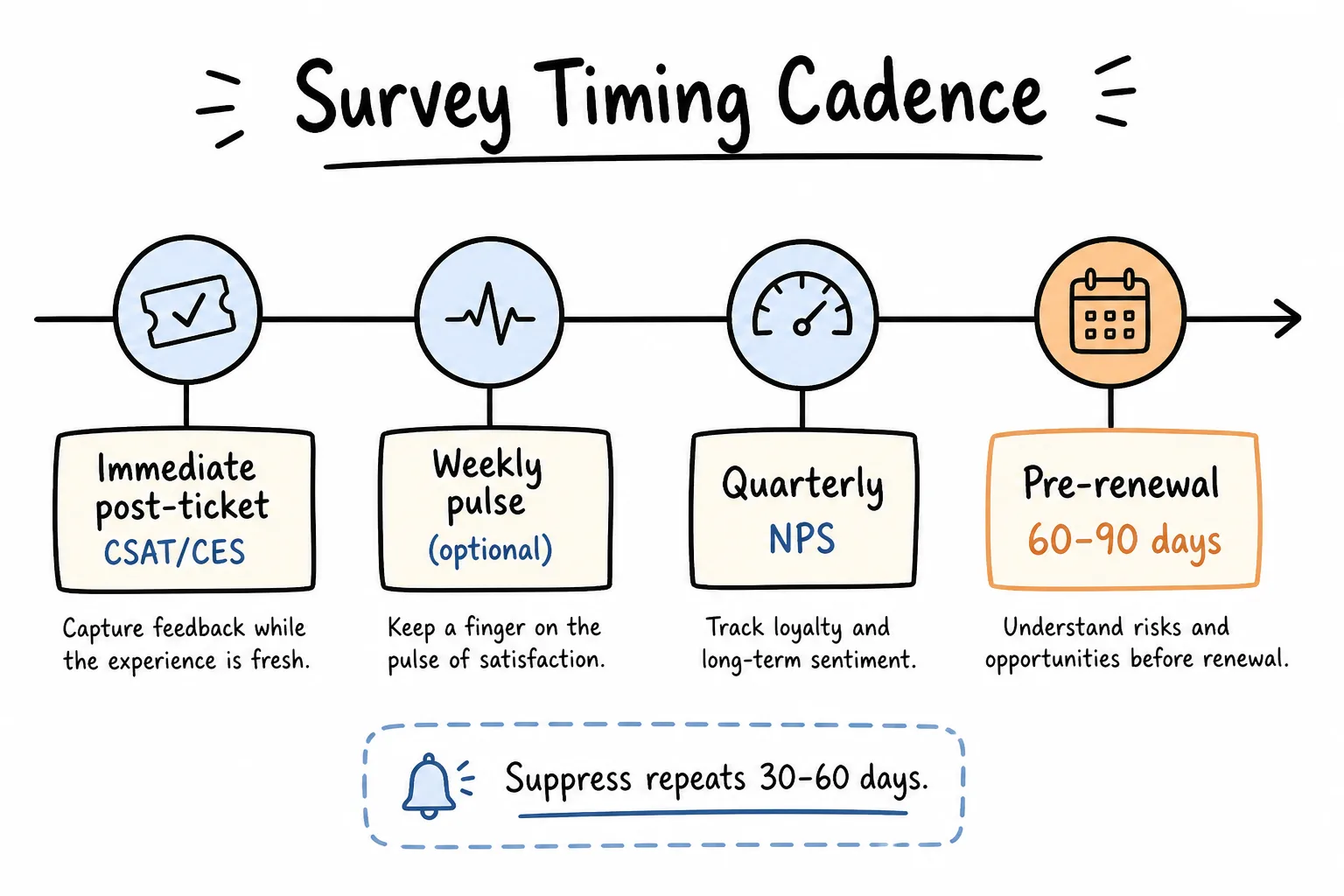
Match metric to moment: CSAT/CES immediately, NPS quarterly, renewal checks 60–90 days out.
| Survey type | Ideal timing | Why |
|---|---|---|
| Post-ticket CSAT / CES | Immediately to within 24 hours of resolution | Memory is freshest; attribution is clean |
| Chat survey | At chat close | In-channel response rates are higher |
| Phone / IVR | End of call or immediate SMS | Keep to one question if IVR |
| Self-service | On article or flow completion | Measures deflection quality |
| Relationship NPS | Quarterly or at lifecycle milestones | Avoids ticket-level noise |
| Pre-renewal | 60–90 days before renewal | Leaves time to recover detractors |
Survey fatigue rules
- Suppress additional surveys for the same person for 30–60 days after a response (adjust for high-touch B2B).
- Do not stack CSAT, CES, and NPS on the same week for one customer.
- Cap relationship surveys at roughly quarterly unless a major incident requires a pulse check.
- Always show customers that feedback led to change - silence teaches people to ignore the next invite.
Warning: A 24-hour delay can be fine for email CSAT, but long delays increase recall bias and lower response rates. Prefer immediate in-product or messaging prompts when the channel allows.
Channels: Where Survey Questions Perform Best
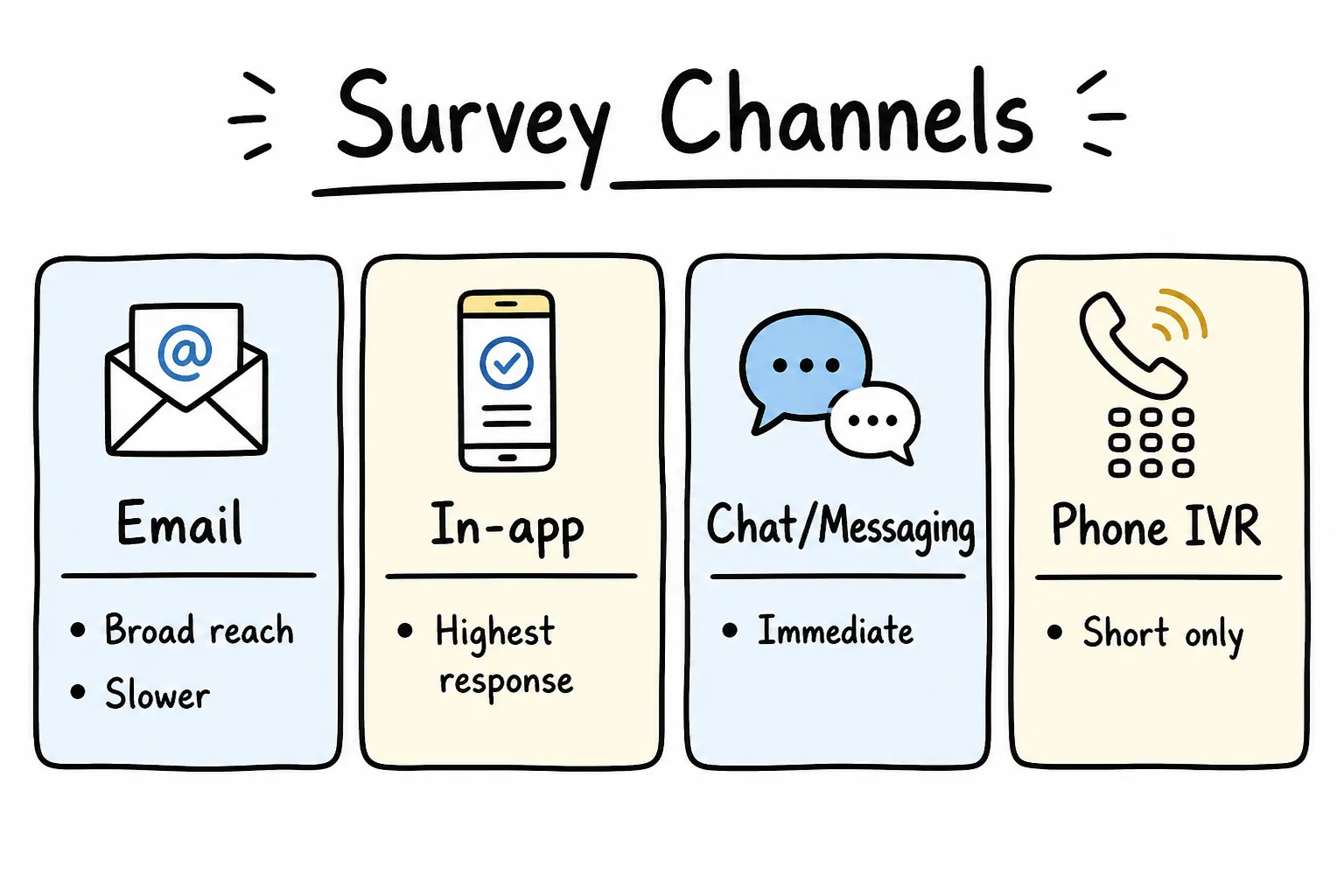
Channel choice changes response rate as much as question wording does.
| Channel | Strengths | Limits | Best question count |
|---|---|---|---|
| Works across segments; good for thoughtful comments | Lower response; delayed | 2–5 | |
| In-app / mobile | Highest engagement when contextual | Easy to over-survey | 1–3 |
| Chat / messaging | Immediate; high completion | Tiny attention window | 1–2 |
| Phone / IVR / SMS | Captures voice-channel reality | Poor for long forms | 1–2 |
| Help center widget | Improves content ops | Biased to self-service users | 1–3 |
In-app and messaging surveys often outperform email because they appear in the same context as the experience. Email still matters for B2B stakeholders who work primarily outside your product.
Best practice: Use the same core metric question across channels so scores remain comparable. Change presentation (emoji vs numbers), not the underlying construct.
How to Write Questions That Customers Actually Answer
Lead with value, not guilt
“Help us improve your next support experience (30 seconds)” outperforms “Please complete our important survey.”
Put the metric first
Ask the score before demographics or long comment boxes. Many people abandon after the first hard question - make the first question the one you need most.
Make open-ended optional on short surveys
Forced essays crush completion. Invite comments; do not require them unless the survey is already a deep-dive interview substitute.
Use consistent scales
If 5 means “Very satisfied” in one question, do not flip anchors later. Inconsistent scales create false trends.
Avoid internal jargon
Customers should not need to know your queue names, severity codes, or product codenames to answer.
Localize thoughtfully
Translate meaning, not just words. Keep scales culturally calibrated, and avoid stuffing long non-English text into illustration-heavy survey UIs.
Respect privacy
Only ask demographic or firmographic questions when they change decisions. Many support surveys need zero demographic fields because ticket metadata already provides context.
How to Analyze Survey Results
Scores without analysis become wallpaper. Build a simple operating rhythm.
1. Calculate and trend the primary metric
Track CSAT, CES, or NPS weekly and monthly. Segment by:
- Channel
- Queue / issue type
- Agent or team (for coaching, not public shaming)
- Plan tier or revenue segment
- New vs existing customers
- AI-handled vs human-handled
2. Read the “why”
Tag open-ended comments into themes: wait time, product bug, policy, agent skill, self-service gap, billing clarity, escalation friction. Even a lightweight weekly tag review beats ignoring verbatims.
3. Close the loop
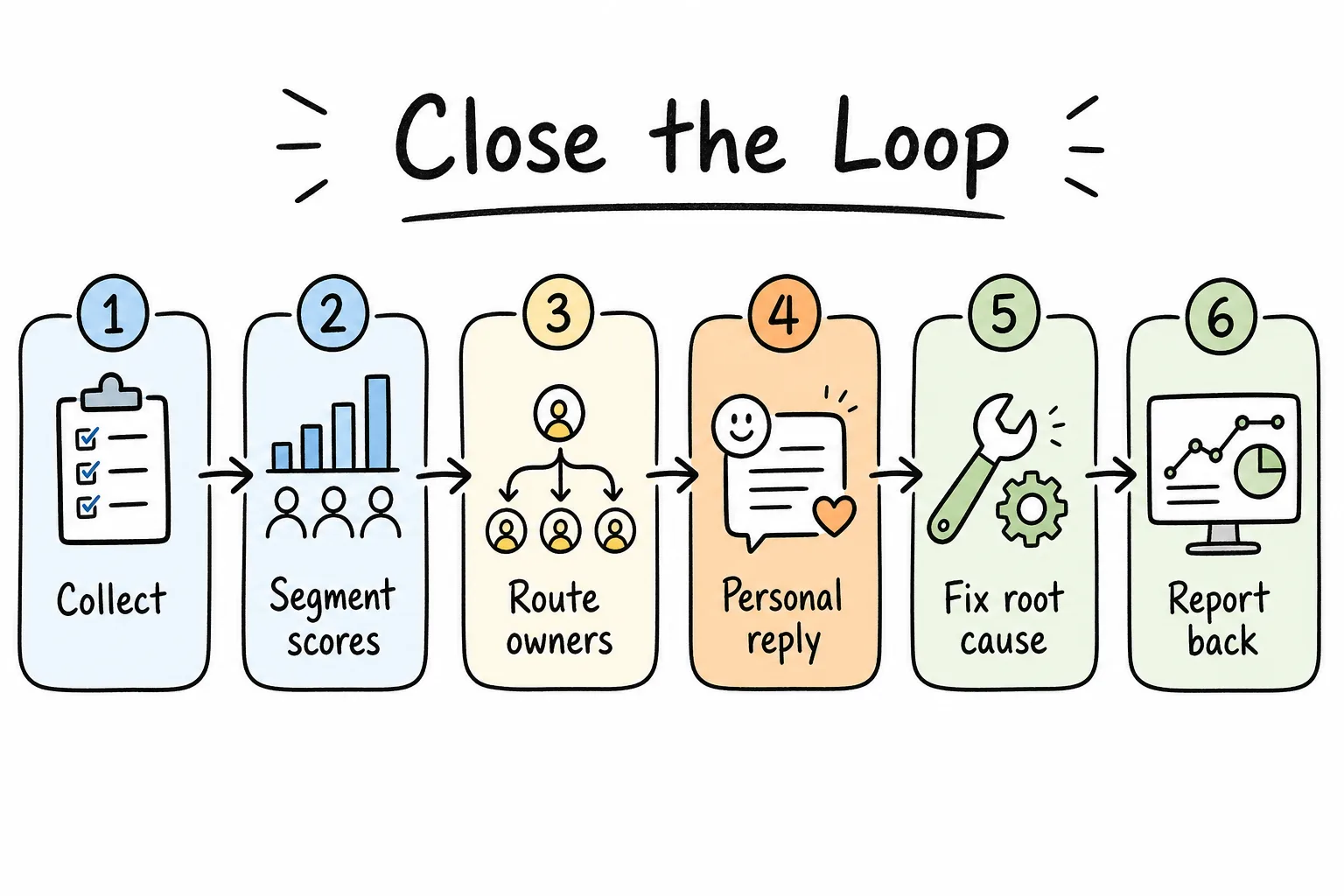
Low scores need personal replies; recurring themes need root-cause fixes and public reporting.
Operational close-the-loop checklist:
- Collect responses in one place.
- Segment promoters, passives, detractors (or CSAT top/bottom box).
- Route owners - support lead for agent issues, product for bugs, CX for process.
- Reply personally to unhappy customers quickly.
- Fix root causes visible in themes, not only individual tickets.
- Report back in release notes, changelog, or customer emails when systemic fixes ship.
Closing the loop is the mechanism that makes surveys worth answering: people reward being heard. CustomerGauge’s VoC benchmarks also stress response coverage-if only the happiest accounts reply, the dashboard lies.
4. Connect surveys to operations metrics
Pair perception metrics with:
- First-contact resolution
- Time to first response
- Time to resolution
- Reopen rate
- Self-service deflection rate
- Transfer rate
- Repeat contact rate
If CSAT is high but reopen rate climbs, your survey may be sampling too early - or agents may be closing tickets before true resolution.
5. Prefer internal baselines over vanity benchmarks
Industry benchmarks help orientation, but methodology differs wildly. Use ACSI-style external context for executive storytelling, then manage to your own baseline and improvement rate. National satisfaction stuck near 76.9 (ACSI Q4 2025) is a reminder that incremental service improvements still matter when revenue looks fine.
Best Practices for Customer Service Survey Programs
- Define the decision before the question. If the answer cannot change staffing, coaching, content, or product, cut the question.
- Use CSAT or CES for tickets; NPS for relationships. Do not average ticket CSAT into a fake loyalty score.
- Keep post-interaction surveys under five questions. Prefer two.
- Always include a path to explain the score. Even one optional comment field.
- Act within days, not quarters, on detractors. Speed rebuilds trust.
- Publish a “you said / we did” note periodically. It raises future response rates.
- Train agents on how surveys are used. Fearful agents game closures; confident agents welcome coaching signal.
- Sample fairly. Avoid surveying only easy tickets if you want operational truth.
- Protect against fatigue with suppression windows.
- Review question wording quarterly. Products, AI coverage, and channels change; questions should too.
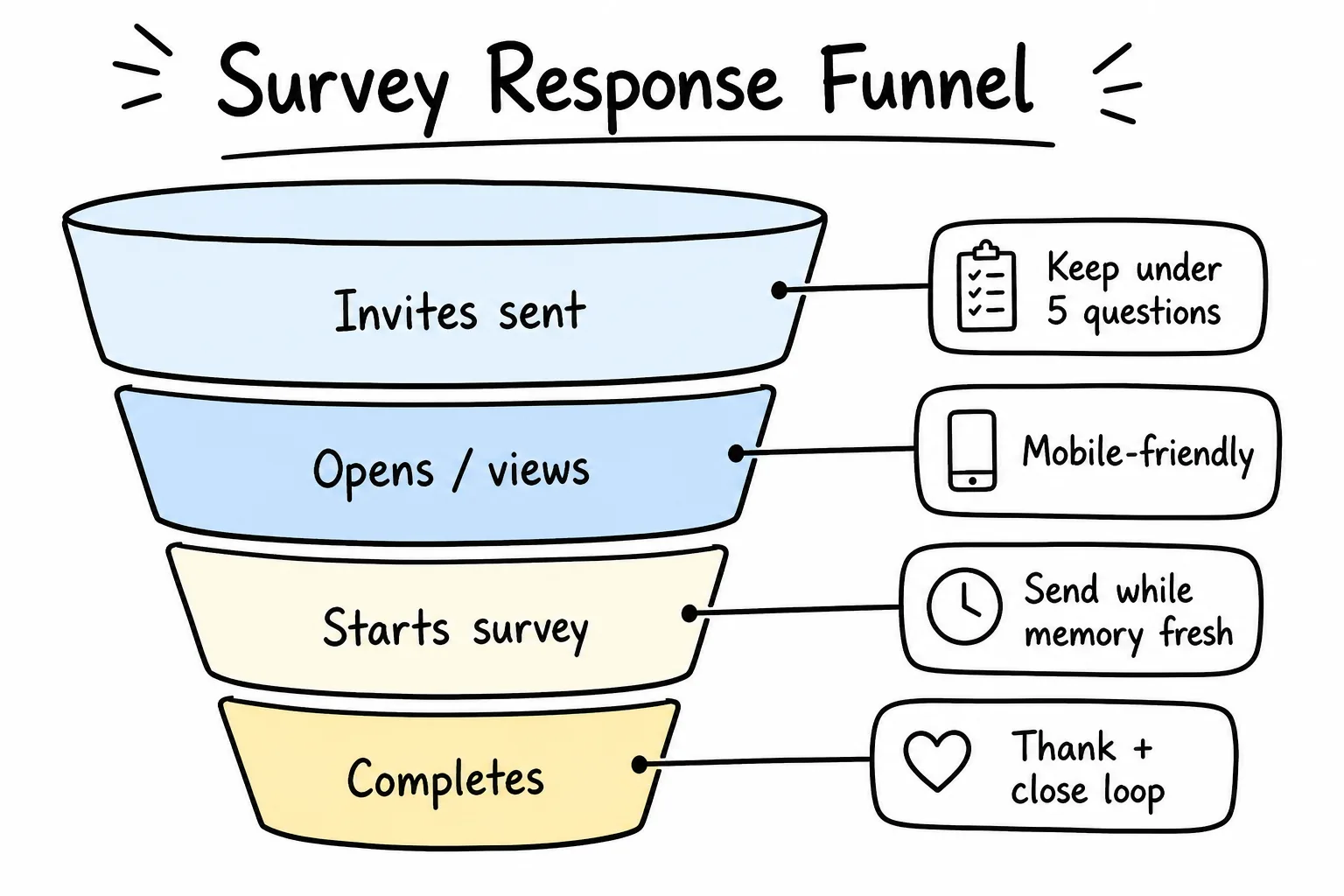
Short, mobile-friendly, timely surveys move more people from invite to completion.
Common Mistakes That Ruin Survey Data
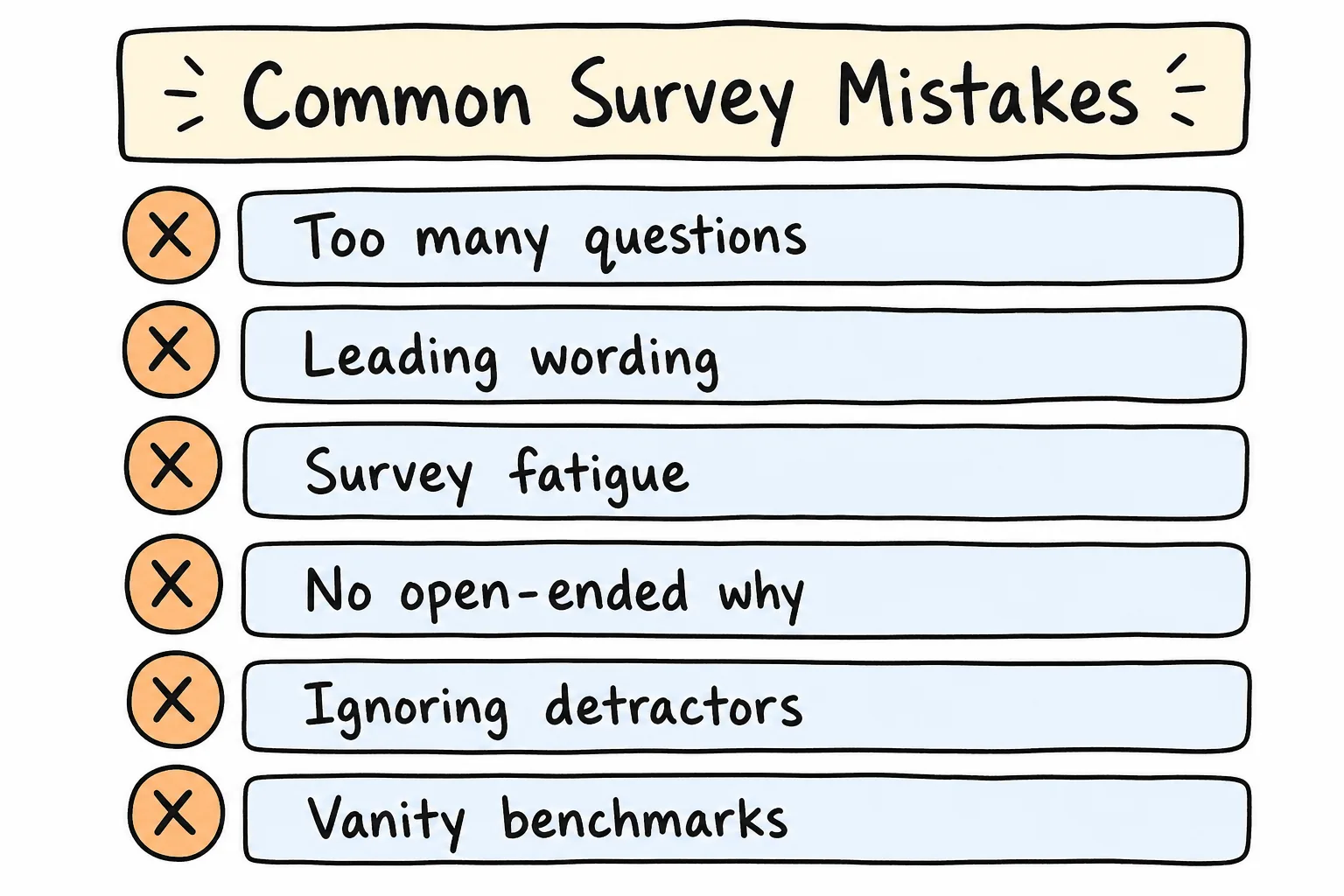
Most bad survey programs fail on design and follow-through, not on tool choice.
Mistake 1: Too many questions
A 20-question “quick” CSAT form is not quick. Cut ruthlessly.
Mistake 2: Leading or loaded wording
“How delighted were you with our world-class agents?” measures flattery, not experience.
Mistake 3: Double-barreled questions
“Was the agent fast and friendly?” hides which attribute failed.
Mistake 4: Surveying at the wrong time
Asking NPS after a password-reset chat confuses a micro-task with brand loyalty.
Mistake 5: No open-ended follow-up
A score of 2 without a why is an alert without a diagnosis.
Mistake 6: Ignoring detractors
Collecting anger and never replying teaches customers that surveys are theater.
Mistake 7: Chasing external benchmarks only
A “good” industry NPS means little if your top accounts are silent or declining.
Mistake 8: Using surveys as the only voice of customer
Combine surveys with ticket themes, churn interviews, app reviews, and sales notes.
Mistake 9: Punishing agents for every low score
Some low scores are product or policy. Coaching systems need root-cause tags, not blame.
Mistake 10: Never retiring questions
Legacy questions about retired channels or old SLAs pollute longitudinal charts. Also avoid treating AI disclosure questions as a substitute for escalation quality-customers care whether they got unstuck, and whether reaching a human was easy when automation failed.
Industry Snapshots: Tailoring Questions by Context
SaaS and software
Prioritize questions on clarity of troubleshooting, admin permissions, incident communication, and escalation from bot to human. CES often outperforms raw CSAT for onboarding and configuration issues.
Suggested mix: 1, 25, 53, 82, 95.
Ecommerce and retail
Focus on order changes, shipping exceptions, returns effort, and refund clarity. Speed and first-contact resolution dominate.
Suggested mix: 1, 23, 35, 55, 96.
B2B and customer success–led teams
Add relationship and account-level questions, but keep ticket surveys short. Track coverage by ARR. Include renewal-adjacent NPS separately from ticket CSAT.
Suggested mix: 8, 40, 61, 87, 94.
Call centers and high-volume help desks
Standardize agent attribute questions for coaching calibration. Monitor transfer and repeat-contact items closely.
Suggested mix: 1, 15, 25, 30, 53.
Startups
Start with one CSAT + one why on every resolved ticket. Add CES for your most painful flow. Delay complex NPS programs until you can close the loop.
Suggested mix: 1, 95 (then expand).
What Is Changing in Support Surveys
Customers increasingly meet bots before humans, so modern banks need questions about automation helpfulness and escalation ease. Measuring only human-agent CSAT hides bot-driven friction.
In-app and messaging surveys usually beat long email forms for transactional feedback-design for one tap plus an optional comment. More teams also treat CES as a leading signal for churn and cost-to-serve, which pushes question libraries toward process friction, repetition, and channel switching.
Close-the-loop should be a system, not a courtesy: route low scores into workflows, include consent to follow up (question 100), and assign owners behind the scenes.
Frequently Asked Questions
What are the best customer service survey questions to start with?
Start with one CSAT question (“How satisfied were you with the support you received today?”), one resolution question (“Was your issue fully resolved?”), and one optional why. That trio covers quality, outcome, and cause without hurting response rates.
How many customer service survey questions should I ask?
For post-interaction surveys, use 1–3 questions. For quarterly relationship surveys, stay near 3–5. Beyond five event-triggered questions, completion usually falls and answer quality declines.
What is the difference between CSAT, NPS, and CES questions?
CSAT asks about satisfaction with a specific interaction. NPS asks about likelihood to recommend the company overall. CES asks how easy the process felt. Use CSAT/CES after tickets; use NPS on a slower cadence.
When should I send a customer service survey?
Send transactional surveys immediately or within 24 hours of resolution. Send NPS quarterly or at milestones such as onboarding completion or pre-renewal (often 60–90 days out).
How do I calculate CSAT from survey questions?
Divide the number of positive responses (typically 4–5 on a 5-point scale) by total responses, then multiply by 100. Example: 80 positives out of 100 responses = 80% CSAT.
What is a good CSAT score for customer support?
It depends on industry, channel, and methodology. Many support organizations treat mid-to-high 70s as a common reference range and high 80s as strong, but your trendline and segment gaps matter more than a single external number. For U.S. economy-wide context, ACSI’s national score was 76.9 in Q4 2025.
Should every support ticket get a survey?
Usually yes for CSAT/CES, with fatigue controls: suppress repeats for a cooling-off window, and exclude tickets where contact is impossible or legally restricted. Do not send relationship NPS on every ticket.
Are open-ended customer service survey questions worth it?
Yes - if optional on short surveys. Verbatims explain the score and often reveal product bugs, policy pain, and knowledge-base gaps that ratings alone cannot.
How can I improve survey response rates?
Shorten the survey, send while memory is fresh, use in-app or messaging where possible, explain the time required, make comments optional, mobile-optimize, and show customers that prior feedback created changes.
Should I survey customers about AI support?
Yes, if AI is part of the journey. Ask whether automation helped, whether escalation to a human was easy, and what the assistant should improve. Avoid questions that only measure novelty.
How often should I change my survey questions?
Keep core metric questions stable for trend integrity. Review attribute and open-ended prompts quarterly, or whenever channels, AI coverage, or policies change.
What should I do with negative survey responses?
Reply quickly, own the issue, resolve if still open, tag the root cause, and feed systemic themes into product, policy, or process work. Closing the loop is part of the survey system - not an extra courtesy.
Can I use the same questions for ecommerce and B2B SaaS?
You can reuse core CSAT/CES/NPS constructs, but tailor attribute questions. Ecommerce needs shipping and returns effort items; B2B SaaS needs admin, escalation, and account communication items.
How do customer service survey questions differ from product feedback questions?
Service questions focus on help interactions: agent quality, resolution, effort, channels, and follow-up. Product questions focus on features, usability, and roadmap. Keep them separate so owners and actions stay clear.
Do I need demographic questions on a support survey?
Usually no. Ticket and CRM data already provide account and contact context. Add demographics only when they change analysis and when privacy expectations allow.
Conclusion
Great customer service survey questions are specific, short, timed to the moment, and tied to an owner who will act. Use CSAT for interactions, CES for friction, and NPS for relationship health. Build from the 100-question bank above-do not deploy it as one form.
Ask fewer, better questions. Read the why. Close the loop. Then ask again.
When you are ready to turn these into live surveys, build them in Formms or follow the prompt-to-form workflow. Share a short link or QR, collect on mobile, and keep the survey short enough that people finish it.