
Blog / How-To Guides
200 Biology Trivia Questions and Answers
Context
Explore a collection of 200 biology trivia questions and answers covering the human body, animals, plants, cells, genetics, and more.
On this page
A good biology trivia night needs questions people can answer out loud, plus answers you can check without arguing. This list gives you 200 biology trivia questions and answers across the human body, animals, plants, cells, genetics, and ecology. Use them for a classroom warm-up, a science club round, or a quiz you send as a form.
Later in this article you will also see how to turn a short set into a shareable Formms quiz, with a live walkthrough.
How to use these biology trivia questions
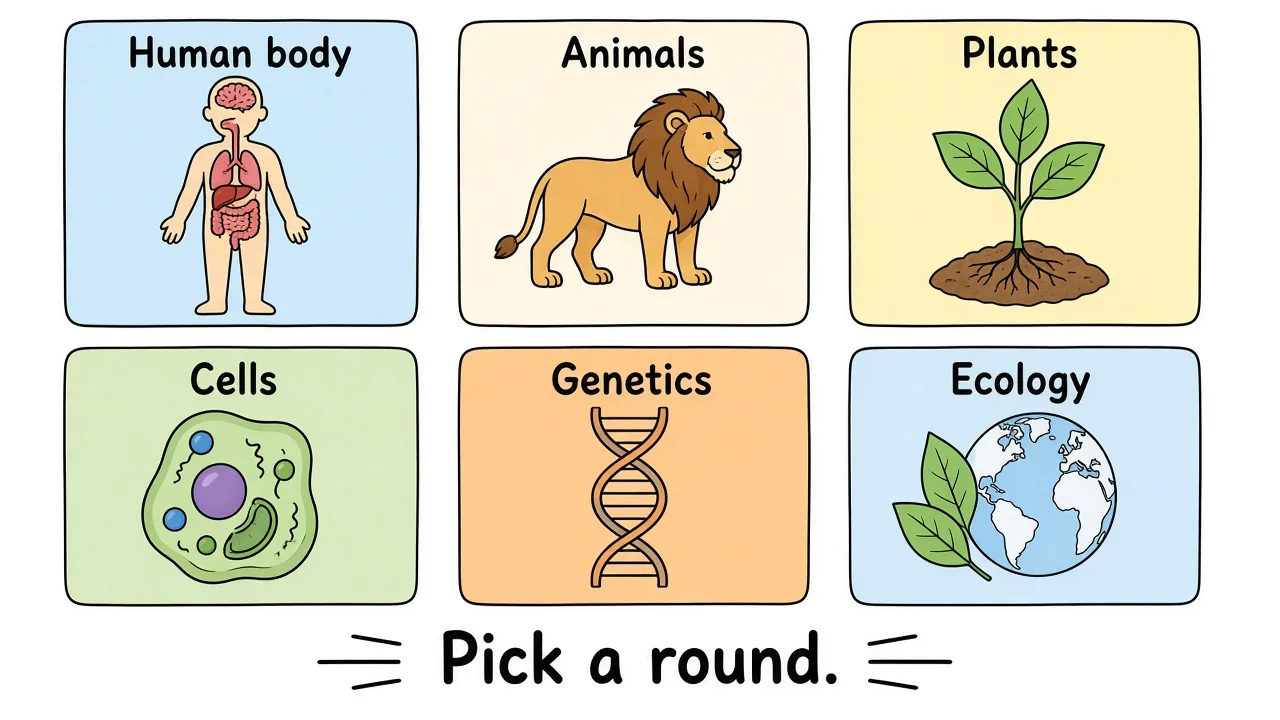
Pick one topic round, or mix easy and medium questions from several sections.
Pick a section that matches your audience. Human body and animals work for mixed ages. Cells and genetics suit a biology class that already knows the vocabulary.
For a live quiz, ask the question, wait for answers, then read the answer line. For a digital round, put five to ten items into a form with multiple choice options and score from the responses later.
Human body trivia questions
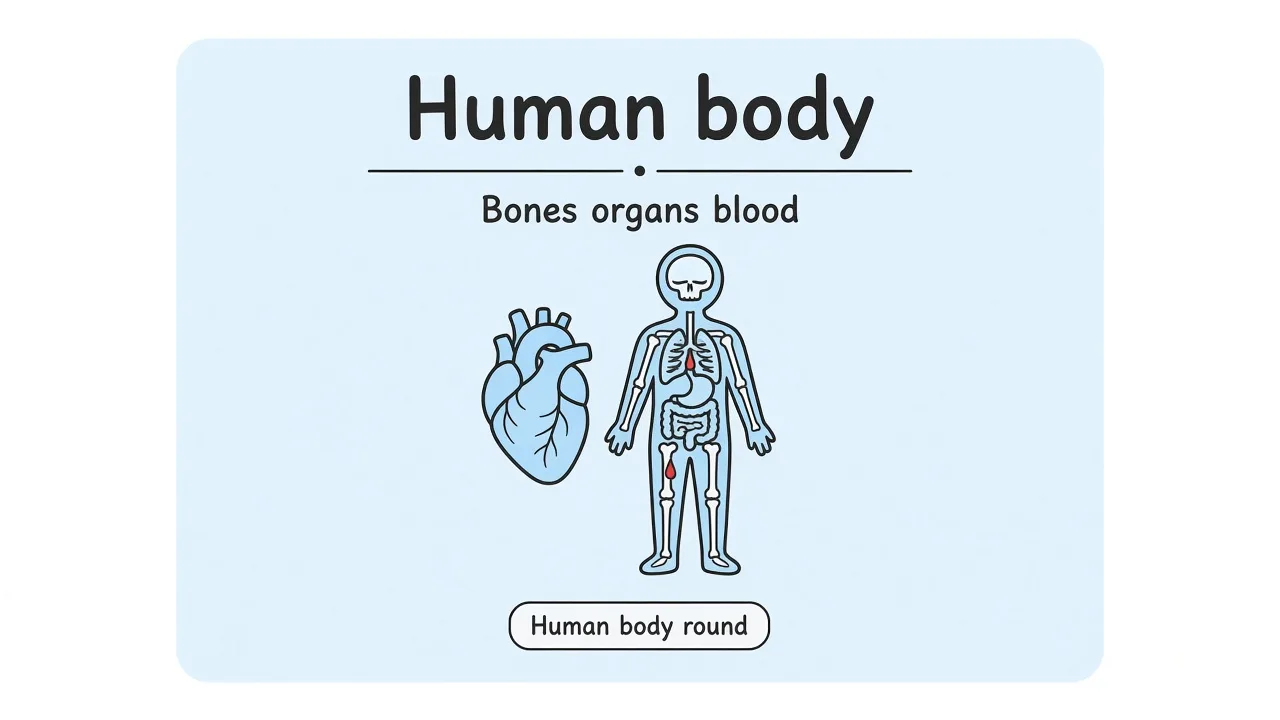
Organs, bones, blood, and everyday body facts.
-
What is the largest organ of the human body?
Answer: The skin -
What is the largest internal organ in the human body?
Answer: The liver -
Which organ pumps blood through the body?
Answer: The heart -
How many bones does a typical adult human skeleton have?
Answer: 206 -
How many chambers does the human heart have?
Answer: Four -
Which blood cells carry oxygen?
Answer: Red blood cells -
Which blood cells help fight infection?
Answer: White blood cells -
What protein in red blood cells binds oxygen?
Answer: Hemoglobin -
Which organ filters blood and produces urine?
Answer: The kidneys -
Which organ produces insulin?
Answer: The pancreas -
Where does most nutrient absorption happen in the digestive tract?
Answer: The small intestine -
Which bone protects the brain?
Answer: The skull (cranium) -
What is the main job of the lungs?
Answer: To exchange oxygen and carbon dioxide -
Which part of the brain controls balance and coordination?
Answer: The cerebellum -
What connects muscle to bone?
Answer: Tendons -
What connects bone to bone at a joint?
Answer: Ligaments -
Which vitamin does skin make when exposed to sunlight?
Answer: Vitamin D -
What is the normal human body temperature in Celsius, roughly?
Answer: About 37 C -
Which blood type is often called the universal donor for red cells?
Answer: O negative -
Which blood type is often called the universal recipient for red cells?
Answer: AB positive -
How many pairs of ribs does a typical adult have?
Answer: 12 pairs -
Which gland sits at the base of the brain and is called the master gland?
Answer: The pituitary gland -
What is the windpipe also called?
Answer: The trachea -
Which sense organ detects light?
Answer: The eye -
What is the colored part of the eye called?
Answer: The iris -
Which organ stores bile?
Answer: The gallbladder -
What is the soft tissue inside bones that makes blood cells?
Answer: Bone marrow -
Which system includes the brain and spinal cord?
Answer: The central nervous system -
What do we call the body’s chemical messengers made by glands?
Answer: Hormones -
Which muscle helps you breathe by contracting below the lungs?
Answer: The diaphragm -
What is the name of the tube that carries food from mouth to stomach?
Answer: The esophagus -
Which vessels carry blood away from the heart?
Answer: Arteries -
Which vessels carry blood back to the heart?
Answer: Veins -
What is the liquid part of blood called?
Answer: Plasma -
How many teeth does a typical adult human have?
Answer: 32
Animal trivia questions
Vertebrates, invertebrates, and how animals live.
-
What is an animal that eats only plants called?
Answer: A herbivore -
What is an animal that eats only other animals called?
Answer: A carnivore -
What is an animal that eats plants and animals called?
Answer: An omnivore -
Which mammal lays eggs and has a duck-like bill?
Answer: The platypus -
What do you call animals with a backbone?
Answer: Vertebrates -
What do you call animals without a backbone?
Answer: Invertebrates -
Which insect is famous for producing honey?
Answer: The honeybee -
What is the largest living land animal?
Answer: The African elephant -
What is the largest animal that has ever lived?
Answer: The blue whale -
Which bird cannot fly and is native to Antarctica?
Answer: The penguin -
What process do insects such as butterflies use to change form?
Answer: Metamorphosis -
Which animal is known for changing color with chromatophores?
Answer: The chameleon -
What do amphibians typically need for reproduction?
Answer: Water or a moist environment -
Which class of animals includes frogs and salamanders?
Answer: Amphibians -
Which class of animals includes snakes and turtles?
Answer: Reptiles -
What is a group of lions called?
Answer: A pride -
Which mammal has a pouch for its young?
Answer: A marsupial -
What is the tallest living land animal?
Answer: The giraffe -
Which sea creature has eight arms?
Answer: An octopus -
What do bees collect from flowers besides nectar?
Answer: Pollen -
How many legs does an insect typically have?
Answer: Six -
What is cold-blooded another common phrase for, in animals?
Answer: Ectothermic -
Which bird is often linked with delivering babies in folklore?
Answer: The stork -
What covering do birds have that helps them fly?
Answer: Feathers -
Which fish is known for migrating upstream to spawn?
Answer: Salmon -
What is a young frog called before it becomes an adult?
Answer: A tadpole -
Which mammal uses echolocation to hunt in the dark?
Answer: A bat -
What is the only flying mammal group?
Answer: Bats -
Which animal has a hard shell and moves slowly on land?
Answer: A tortoise (or turtle) -
What do spiders use to catch prey?
Answer: Silk webs (many species) -
Which large cat has stripes?
Answer: The tiger -
What is a baby kangaroo called?
Answer: A joey -
Which shelled reptile lives mostly in water?
Answer: A turtle -
What gas do most animals need to breathe?
Answer: Oxygen -
What is the hard outer covering of many insects called?
Answer: An exoskeleton
Plant trivia questions
Photosynthesis, leaves, flowers, and seeds.
-
What process do plants use to make food from sunlight?
Answer: Photosynthesis -
Which green pigment captures light energy in plants?
Answer: Chlorophyll -
Which gas do plants take in during photosynthesis?
Answer: Carbon dioxide -
Which gas do plants release during photosynthesis?
Answer: Oxygen -
What plant tissue carries water upward from roots?
Answer: Xylem -
What plant tissue carries sugars from leaves?
Answer: Phloem -
What do we call the male part of a flower that produces pollen?
Answer: The stamen -
What do we call the female part of a flower that receives pollen?
Answer: The pistil (or carpel) -
What is the sticky tip of the pistil called?
Answer: The stigma -
Where does most photosynthesis happen in a leaf?
Answer: In the mesophyll (chloroplast-rich cells) -
What tiny openings on leaves allow gas exchange?
Answer: Stomata -
What do plants take from the soil through their roots?
Answer: Water and minerals -
What is a plant that lives for only one growing season called?
Answer: An annual -
What is a plant that lives for many years called?
Answer: A perennial -
Which organelle in plant cells contains chlorophyll?
Answer: The chloroplast -
What sugar do plants commonly produce in photosynthesis?
Answer: Glucose -
What hard material strengthens wood and many plant cell walls?
Answer: Lignin (cellulose is also key) -
What is the main component of plant cell walls?
Answer: Cellulose -
What do we call the seed leaves of a young plant?
Answer: Cotyledons -
Monocots typically have flower parts in multiples of what number?
Answer: Three -
Dicots typically have flower parts in multiples of what number?
Answer: Four or five -
What is pollination?
Answer: Transfer of pollen to a stigma -
What is germination?
Answer: The sprouting of a seed into a young plant -
Which tree is known for its maple syrup sap?
Answer: The sugar maple -
What do carnivorous plants such as the Venus flytrap catch?
Answer: Insects and other small animals -
What is the waxy layer on many leaves that reduces water loss?
Answer: The cuticle -
What do we call plants that do not produce flowers or seeds, such as ferns?
Answer: Spore-producing plants -
What is a fruit, botanically speaking?
Answer: A mature ovary that contains seeds -
Which desert plant stores water in thick stems?
Answer: A cactus -
What do legumes often host in their roots to fix nitrogen?
Answer: Rhizobium bacteria
Cell biology trivia questions
Organelles, membranes, mitosis, and DNA basics.
-
What is the basic unit of life?
Answer: The cell -
Who coined the term cell after viewing cork under a microscope?
Answer: Robert Hooke -
Which organelle is often called the powerhouse of the cell?
Answer: The mitochondrion (mitochondria) -
Which organelle contains most of a eukaryotic cell’s DNA?
Answer: The nucleus -
Which structures assemble proteins?
Answer: Ribosomes -
Which organelle packages and ships proteins?
Answer: The Golgi apparatus -
What is the gel-like fluid inside a cell called?
Answer: The cytoplasm (cytosol is the fluid portion) -
What controls what enters and leaves the cell?
Answer: The cell (plasma) membrane -
Do prokaryotic cells have a nucleus?
Answer: No -
Name one example of a prokaryote.
Answer: Bacteria (or archaea) -
What is osmosis?
Answer: Diffusion of water across a selectively permeable membrane -
What is diffusion?
Answer: Movement of particles from higher to lower concentration -
Which organelle digests worn-out parts in animal cells?
Answer: Lysosomes -
Which structure gives plant cells rigidity outside the membrane?
Answer: The cell wall -
What is the network of membranes involved in making and folding proteins?
Answer: The endoplasmic reticulum -
Rough ER is rough because it is studded with what?
Answer: Ribosomes -
What molecule stores and transfers energy in cells?
Answer: ATP -
What is mitosis?
Answer: Cell division that produces two genetically identical cells -
What is meiosis?
Answer: Cell division that produces gametes with half the chromosomes -
How many daughter cells does mitosis typically produce?
Answer: Two -
How many daughter cells does meiosis typically produce?
Answer: Four -
What phase of the cell cycle is DNA copied?
Answer: S phase (synthesis) -
What are the stages of mitosis in order?
Answer: Prophase, metaphase, anaphase, telophase -
What is a vacuole’s main role in many plant cells?
Answer: Storage and maintaining turgor pressure -
Which organelle is thought to have come from engulfed cyanobacteria?
Answer: Chloroplasts -
Which organelle is thought to have come from engulfed aerobic bacteria?
Answer: Mitochondria -
What is the endosymbiotic theory about?
Answer: How mitochondria and chloroplasts originated from symbiotic bacteria -
What shape is often used to describe a DNA molecule?
Answer: A double helix -
What are the building blocks of proteins?
Answer: Amino acids -
What are the building blocks of DNA?
Answer: Nucleotides -
Which base pairs with adenine in DNA?
Answer: Thymine -
Which base pairs with guanine in DNA?
Answer: Cytosine -
Which base replaces thymine in RNA?
Answer: Uracil -
What is transcription?
Answer: Copying DNA into RNA -
What is translation?
Answer: Building a protein from an mRNA code
Genetics trivia questions
Genes, alleles, chromosomes, and inheritance.
-
What does DNA stand for?
Answer: Deoxyribonucleic acid -
What does RNA stand for?
Answer: Ribonucleic acid -
How many chromosomes does a typical human body cell have?
Answer: 46 (23 pairs) -
How many chromosomes does a typical human sperm or egg cell have?
Answer: 23 -
Who is often called the father of genetics for his pea plant experiments?
Answer: Gregor Mendel -
What are different versions of the same gene called?
Answer: Alleles -
What is a genotype?
Answer: The genetic makeup of an organism -
What is a phenotype?
Answer: The observable traits of an organism -
What does homozygous mean?
Answer: Two identical alleles for a trait -
What does heterozygous mean?
Answer: Two different alleles for a trait -
In a simple dominant-recessive cross of two heterozygotes, what phenotype ratio is classic?
Answer: 3 dominant : 1 recessive -
What is a Punnett square used for?
Answer: Predicting offspring genotype probabilities -
What is a codon?
Answer: Three nucleotides that code for an amino acid -
What is a mutation?
Answer: A change in the DNA sequence -
What are sex chromosomes in humans typically labeled?
Answer: X and Y -
Which sex chromosomes does a typical human male have?
Answer: XY -
Which sex chromosomes does a typical human female have?
Answer: XX -
What is heredity?
Answer: Passing traits from parents to offspring -
What molecule did Rosalind Franklin’s Photo 51 help reveal the structure of?
Answer: DNA -
Watson and Crick proposed which structure for DNA?
Answer: The double helix -
What is a gene?
Answer: A segment of DNA that codes for a product, often a protein -
What is a genome?
Answer: An organism’s complete set of genetic material -
What is cloning in the sense of Dolly the sheep?
Answer: Creating a genetic copy of an organism -
What kind of animal was Dolly, the first mammal cloned from an adult cell?
Answer: A sheep -
What are jumping genes that move within the genome called?
Answer: Transposons (transposable elements) -
Barbara McClintock discovered jumping genes while studying which crop?
Answer: Maize (corn) -
What is incomplete dominance?
Answer: A heterozygous phenotype that is intermediate -
What is codominance?
Answer: Both alleles are fully expressed in the heterozygote -
Blood types A and B showing together in AB is an example of what?
Answer: Codominance -
What is a pedigree chart used for?
Answer: Tracing inheritance of a trait in a family -
What is genetic engineering?
Answer: Directly changing an organism’s DNA -
What does PCR stand for in molecular biology?
Answer: Polymerase chain reaction -
What does PCR do?
Answer: It amplifies specific DNA segments -
What is a karyotype?
Answer: A picture of an organism’s chromosomes arranged by size -
Down syndrome is most often linked to an extra copy of which chromosome?
Answer: Chromosome 21
Ecology and more biology trivia
Food chains, biomes, microbes, and big-picture biology.
-
What is an ecosystem?
Answer: A community of living things and their physical environment -
What is a food chain?
Answer: A path of who eats whom, starting from producers -
What sits at the base of most food chains?
Answer: Producers such as plants or algae -
What is a producer in ecology?
Answer: An organism that makes its own food, usually by photosynthesis -
What is a consumer in ecology?
Answer: An organism that eats other organisms -
What is a decomposer?
Answer: An organism that breaks down dead matter, such as fungi or many bacteria -
What is biodiversity?
Answer: The variety of living organisms in an area -
What is a habitat?
Answer: The place where an organism lives -
What is a niche?
Answer: An organism’s role and way of living in its ecosystem -
What is symbiosis?
Answer: A close long-term interaction between different species -
What is mutualism?
Answer: A symbiotic relationship that benefits both species -
What is parasitism?
Answer: A relationship where one organism benefits and the other is harmed -
What is commensalism?
Answer: A relationship where one benefits and the other is largely unaffected -
What gas do humans mainly exhale that plants can use?
Answer: Carbon dioxide -
What is the water cycle?
Answer: The movement of water between Earth, atmosphere, and living things -
What is the carbon cycle?
Answer: How carbon moves through air, land, water, and organisms -
What is natural selection?
Answer: Differential survival and reproduction based on heritable traits -
Who proposed natural selection along with ideas that shaped modern evolutionary theory?
Answer: Charles Darwin (and Alfred Russel Wallace independently) -
What is extinction?
Answer: When a species has no living members left -
What is an invasive species?
Answer: A non-native species that spreads and harms an ecosystem -
What is a keystone species?
Answer: A species with an outsized effect on its ecosystem -
What is carrying capacity?
Answer: The maximum population an environment can sustain -
What is a biome?
Answer: A large region defined by climate and characteristic life, such as tundra or rainforest -
Which biome is known for very low temperatures and permafrost?
Answer: Tundra -
Which biome has the highest biodiversity among terrestrial biomes?
Answer: Tropical rainforest -
What do vaccines help the immune system learn to recognize?
Answer: Pathogens or their components -
What is a virus?
Answer: An infectious agent that needs a host cell to replicate -
Are viruses generally considered fully living organisms?
Answer: No, they are usually described as acellular and host-dependent -
What is antibiotic resistance?
Answer: When microbes survive drugs designed to kill them -
What is homeostasis?
Answer: Keeping internal conditions stable
How to create a biology trivia quiz with Formms
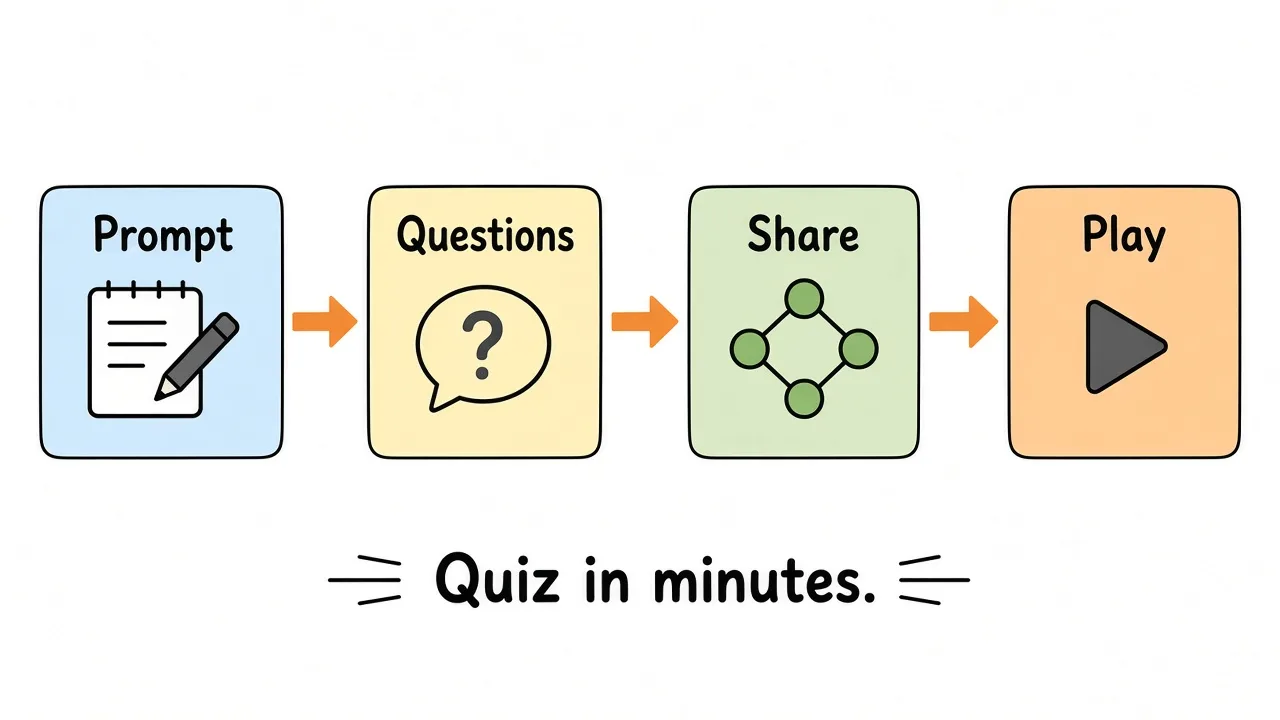
Describe the quiz, review the draft questions, then share a link or QR code.
You do not need to paste all 200 questions into one form. A strong trivia form is short: a name field, five to eight multiple choice items, and a clear submit button. Formms can draft that from a plain-language prompt, then you edit anything that looks wrong.
Start from the free template
Open the biology trivia quiz template. It already has seven classic questions with one correct option each. Duplicate the idea, swap in questions from this article, and publish.
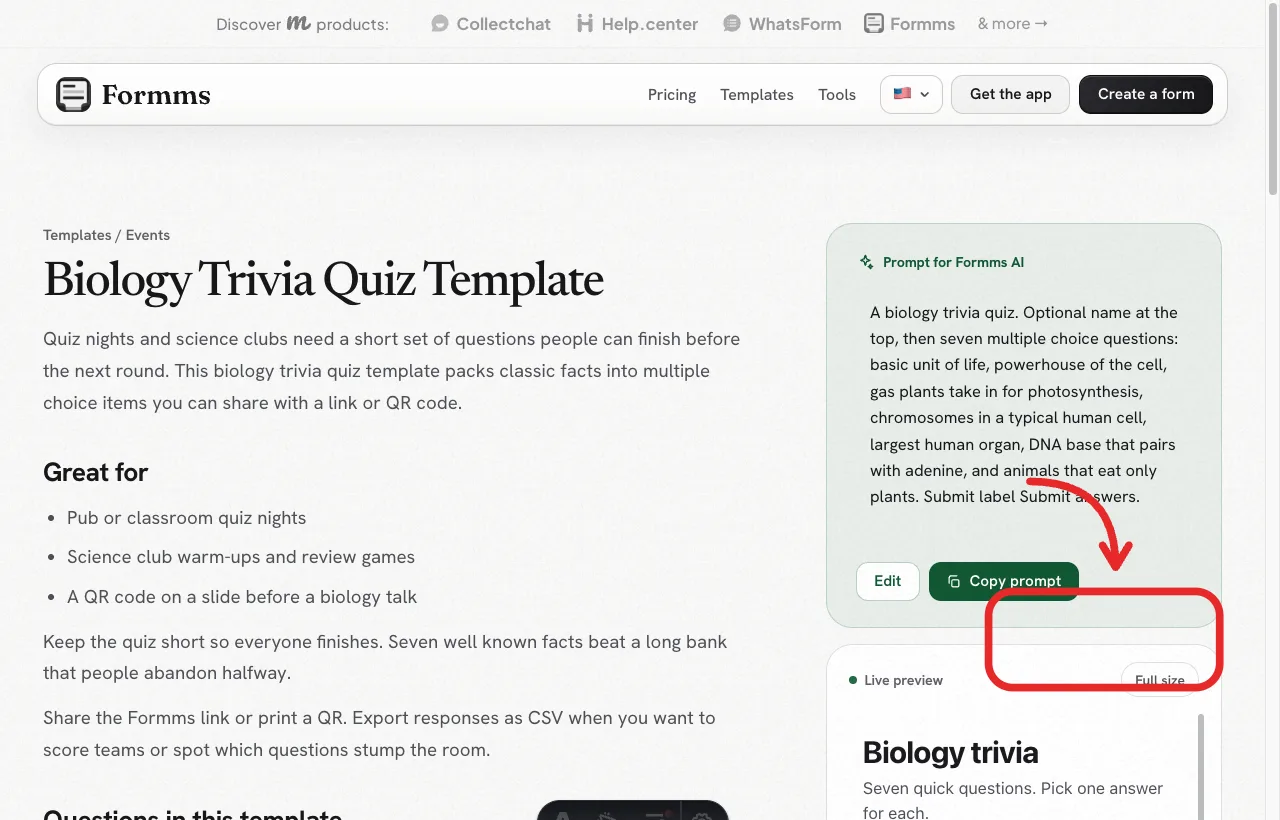
The template page shows a live preview you can try before you copy it into your account.
Or describe the quiz to AI
In the Formms dashboard, start a new form and describe what you want. Say who will play, how many questions, and that answers should be multiple choice.

Start a new form from the dashboard when you want a fresh quiz.
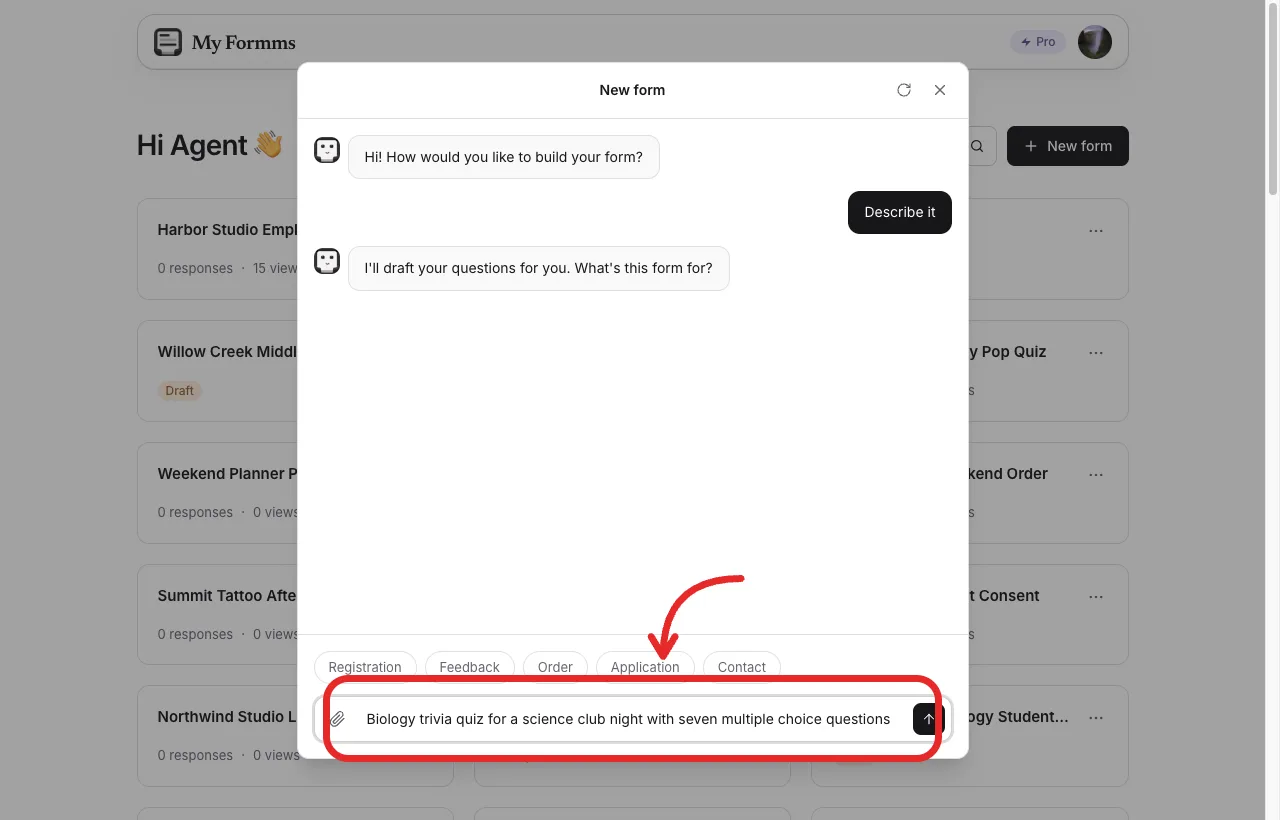
A clear prompt names the topic, the number of questions, and the format.
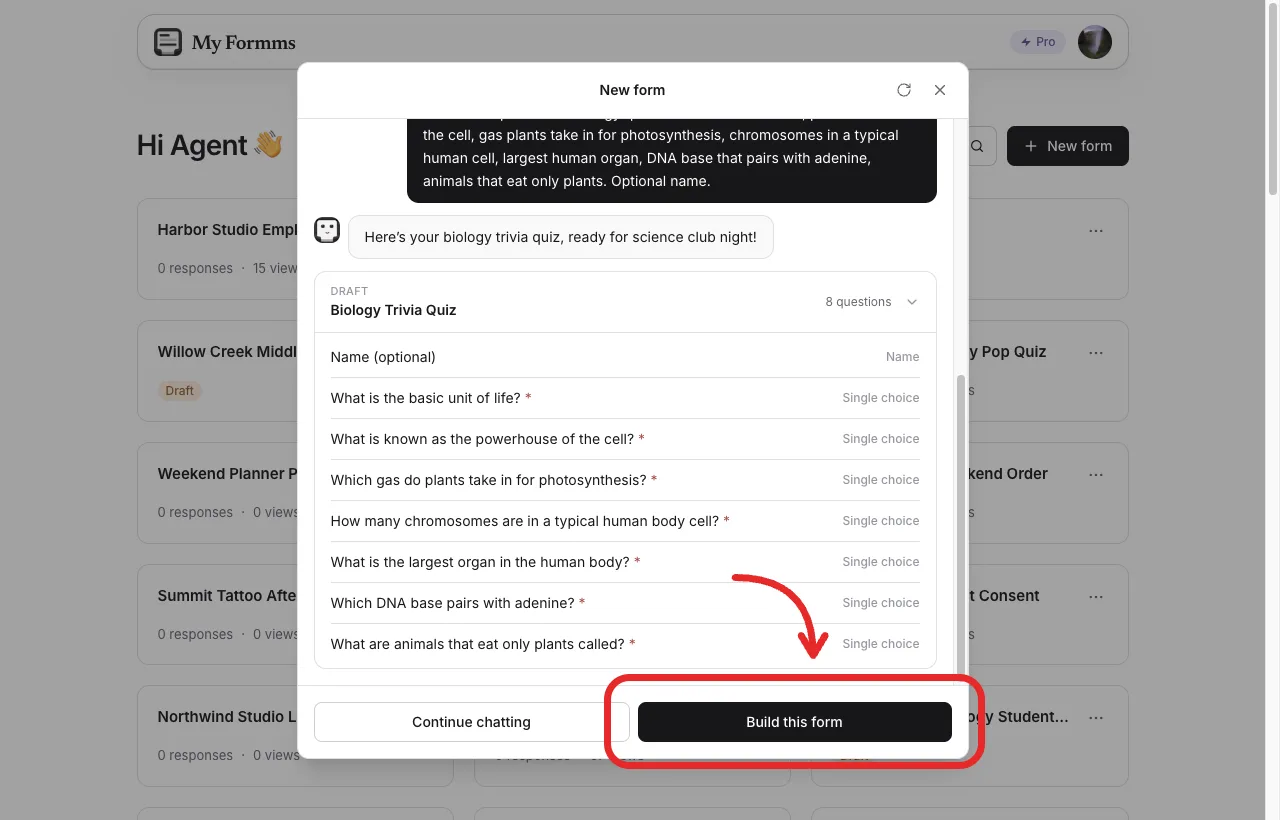
Review every option. Trivia only works when one answer is clearly right.
Share the quiz
Publish, then copy the short link or download a QR code. Players open it on a phone. You get a notification when someone finishes, and you can export CSV if you want to score teams.
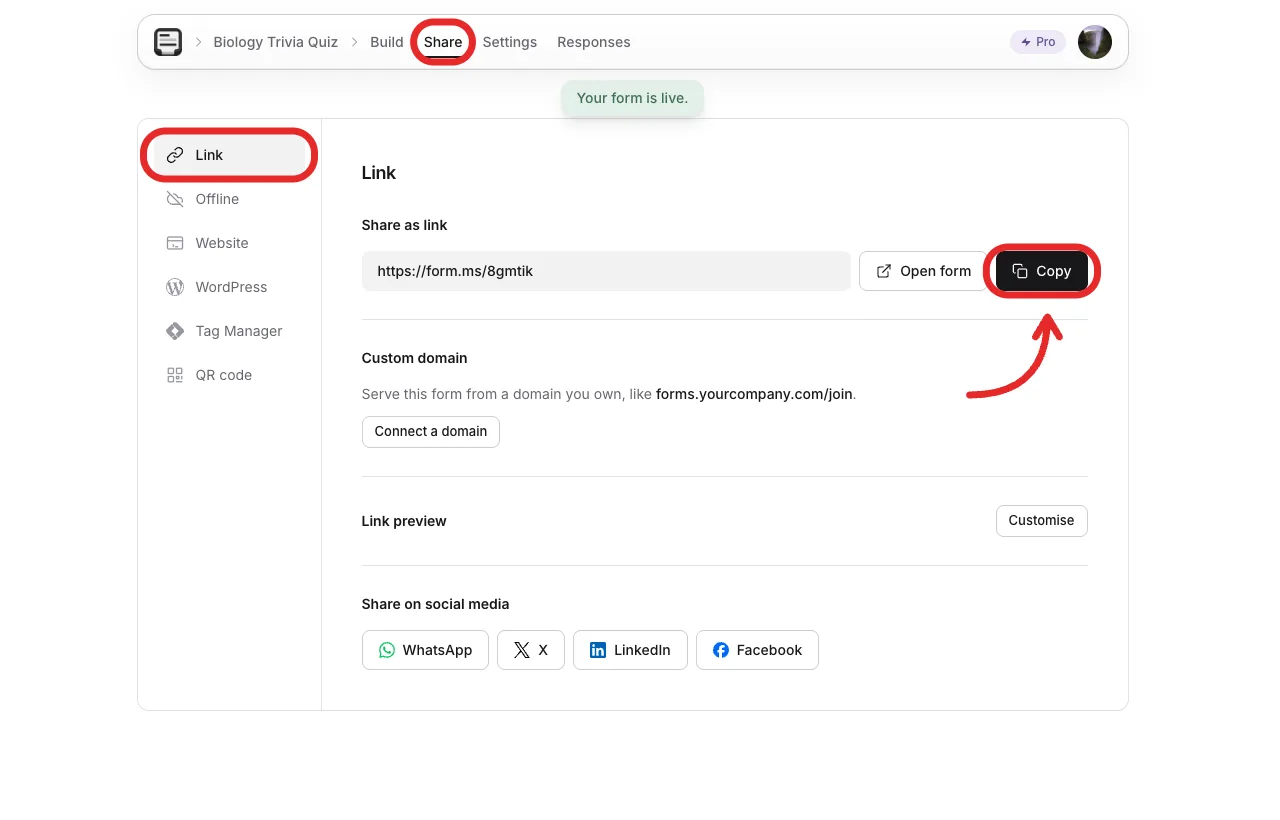
Send the short link in chat, or put the QR on a slide.

A QR code works well for classroom screens and pub quiz sheets.
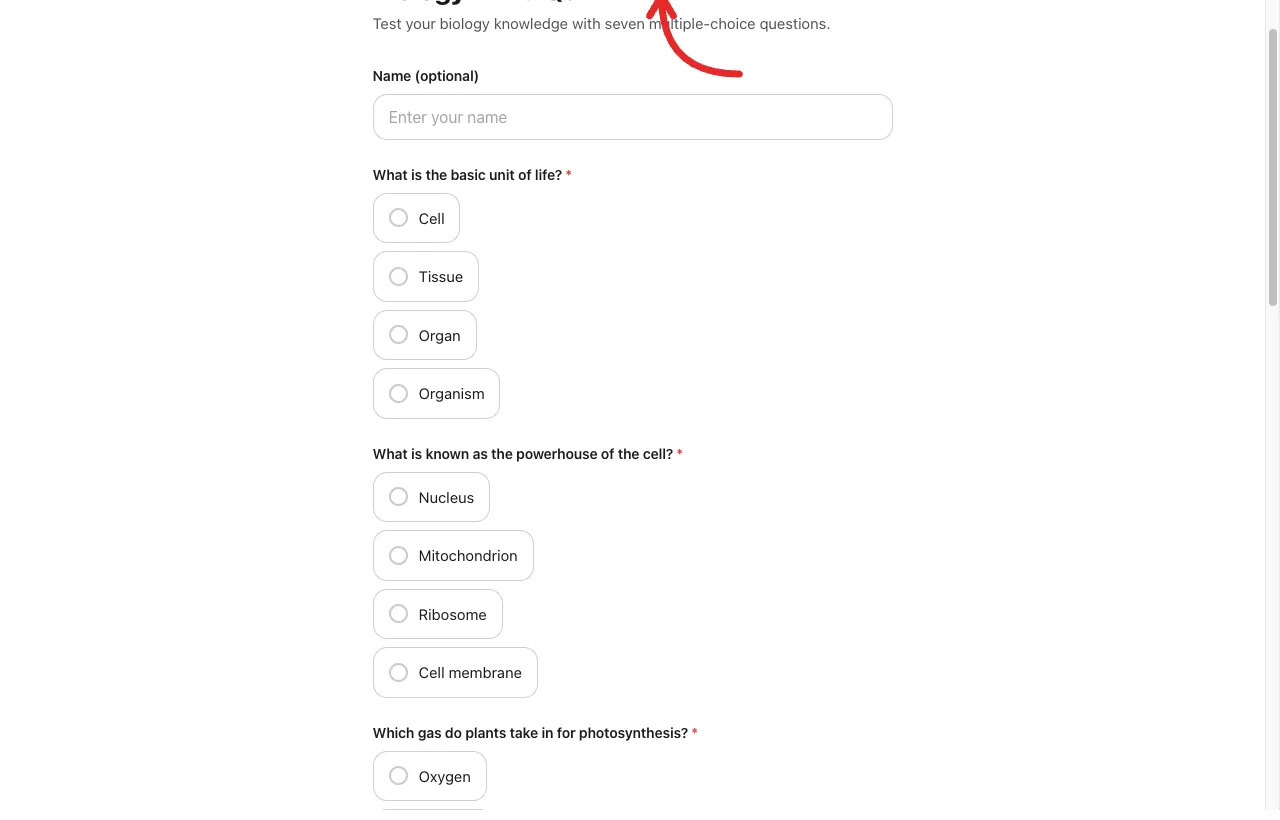
Players pick one option per question and submit when they are done.
Live sample from this walkthrough: form.ms/8gmtik.
If you want a wider walkthrough of AI survey building, see how to create surveys with AI. For classroom collection habits, student surveys pair well with short quizzes.
Tips for hosting biology trivia
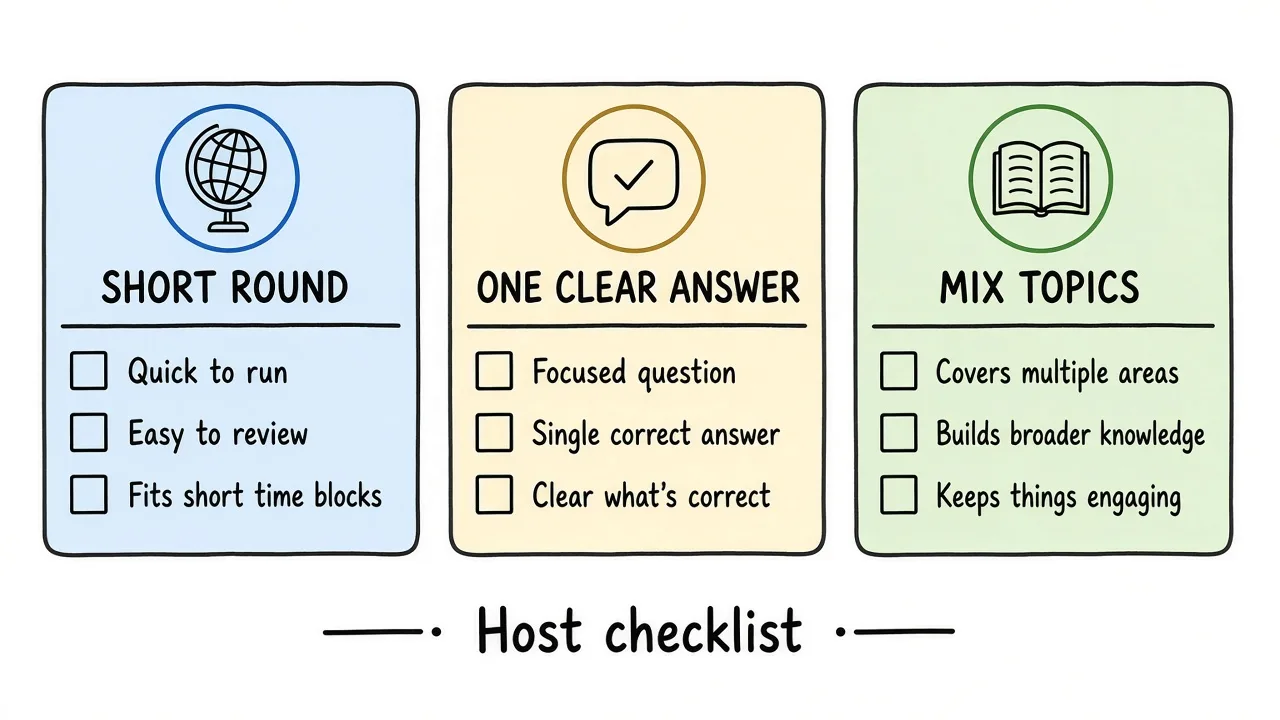
Short rounds, one clear answer, and a mix of easy and medium questions.
- One correct answer. If a question has two fair answers, rewrite it.
- Say the source of truth out loud. For school use, stick to what your textbook already taught.
- Mix topics. A genetics question after an animal question resets attention.
- Score lightly. A Formms response list is enough for most nights. You do not need a fancy leaderboard to start.
- End with something everyone knows. Leave people laughing, not stuck on codon tables.
FAQ
How many biology trivia questions should I use in one quiz?
Five to ten is enough for a form people finish. Use this bank of 200 when you want fresh rounds over a term, not one giant form.
Can I use these questions in a classroom?
Yes, for informal review and game nights. They are general knowledge items, not a substitute for your curriculum or exam board wording.
How do I turn these into a multiple choice form?
Pick a question, write the correct answer plus three plausible wrong options, and use a single-choice field. The biology trivia quiz template shows the shape.
Does Formms grade the quiz automatically?
Formms collects answers. You compare them to the answer key (this article or your own). Export CSV when you want to score offline.
Where can I find more form ideas for school?
Browse student interest surveys and other education templates on the templates hub, or read how to create a free form with unlimited responses.
Conclusion
You now have 200 biology questions to pull from, along with a simple way to turn a handful into a short digital quiz. Choose five to ten that fit your group, check the wording against what they have learned, and save the rest for another round. When you are ready, build the first quiz using Formms, share the link, and let the responses guide what you ask next.